FAKE HOA CUFFED MY DAUGHTER “FOR FUN”—SO I HIT BACK WITH THE LAW AND WATCHED HIS FAKE BADGE DIE IN COURT
part 2
“Your daughter interfered with an official HOA inspection,” he said. “She refused a lawful order. She is being detained until we complete our assessment and receive payment for outstanding violations.”
I stopped three feet from him.
Close enough for him to hear me clearly.
Far enough that no one could claim I touched him.
“There is no HOA in this neighborhood.”
Kowalski lifted the clipboard like a shield.
“This property has twelve thousand dollars in outstanding Brookfield HOA violations. Unapproved landscaping. Unauthorized driveway modifications. Failure to submit architectural review forms. Noncompliant exterior storage. Obstruction of enforcement activity.”
I looked at him.
“Brookfield has no HOA. I verified that before I bought this house.”
Petrov turned his tablet toward me. On the screen was a document with a fake county seal and a list of supposed violations.
“This section was annexed into Brookfield HOA last month,” he said. “Notice was issued. Your property is now subject to enforcement authority.”
Emma whimpered and tried to shift her weight.
The cuff cut deeper.
I saw a thin line of blood at her wrist.
My vision narrowed for half a second.
Only half.
Then training took over—not military training, not police training, but courtroom training. The kind that teaches you that if you want someone destroyed legally, you do not interrupt them too soon. You let them finish building the record.
I raised my phone and began recording.
“This is Adam Whitaker at 847 Ashford Lane,” I said, keeping my voice steady. “Three men in tactical vests are on my private property claiming false HOA authority. One of them has handcuffed my nineteen-year-old daughter without lawful authority. She is injured. They are demanding money.”
Sheffield’s eyes flicked to the phone.
“Recording enforcement personnel without consent is another violation.”
“No,” I said. “It’s evidence.”
His jaw tightened.
“Your daughter stays detained until you cooperate.”
“Say that again.”
He hesitated.
The smile slipped.
I took one step closer, still not touching him.
“You are using physical restraint to force payment of an alleged debt. That is not HOA enforcement. That is extortion. That is false imprisonment. That is assault and battery. And every second those cuffs remain on my daughter increases your exposure.”
Kowalski shifted his weight.
Petrov glanced toward the truck.
Sheffield tried to reclaim the scene by lifting the key.
“Maybe if you pay the twelve thousand dollars, we can discuss releasing her.”
Emma sobbed.
That was enough.
I dialed 911.
## BODY
“911. What is your emergency?”
“I need police and medical response at 847 Ashford Lane in Brookfield,” I said. “Three men are trespassing on my property. They have handcuffed my daughter. They are claiming fake HOA authority and demanding payment. My daughter is injured.”
The operator asked whether weapons were visible.
“I do not see firearms,” I said. “One subject has the cuff key. Three adult males. Black sleeveless tactical vests. Unmarked silver Silverado. My daughter is nineteen, restrained, crying, and injured.”
Sheffield stepped toward me.
“You just made this worse.”
I kept the phone between us.
“No. You did that when you put hands on her.”
Kowalski began writing on his clipboard.
“Additional violation. Harassment of enforcement personnel. Refusal to permit inspection. Interference with HOA officer duties.”
I almost laughed. Not because any of this was funny, but because I had cross-examined better liars on misdemeanor calendars before lunch.
“You are not officers,” I said.
Petrov said, “You’ll regret that statement when foreclosure begins.”
“Good. Say foreclosure clearly for the recording.”
He stopped.
There it was again.
The awareness.
These men were not confused volunteers. They knew what words sounded frightening. They knew which threats made homeowners panic. They knew how to look official enough to buy themselves time.
But they did not know my world.
They did not know that every sentence they spoke could become an exhibit.
They did not know that my brain was already arranging charges in neat columns.
False imprisonment.
Assault.
Battery.
Extortion.
Criminal impersonation.
Conspiracy.
Fraud.
Attempted theft by deception.
Possession of forged instruments.
Possible kidnapping enhancement depending on state interpretation and restraint facts.
Civil claims.
Punitive damages.
Medical documentation.
Emotional distress.
Attorney fees.
I knew the road.
They were walking themselves down it.
“Dad,” Emma whispered. “Please make him take them off.”
I turned slightly toward her.
“Sweetheart, listen to me. Don’t pull against the cuff. Keep your fingers moving if you can. Help is coming. I’m right here.”
“It burns.”
“I know.”
Sheffield rolled his eyes.
That one small movement nearly broke my restraint.
I felt it. The heat in my chest. The old animal part of me that did not care about courtrooms, records, or procedure. The father part. The part that wanted to put Sheffield on the pavement and make him understand pain without legal terminology.
But he wanted that.
I saw it then.
He wanted me to swing.
If I hit him, he could claim the homeowner attacked official enforcement. If I shoved him, he could muddy the record. If I threatened him, he could pretend his restraint of Emma had been justified by the father’s aggression.
So I gave him nothing.
Nothing except the camera.
Nothing except my voice.
Nothing except the law closing around him one word at a time.
The first patrol car arrived in under seven minutes.
The second came right behind it.
Two Charlotte-Mecklenburg officers stepped out fast but controlled. The lead officer was Sergeant Miguel Torres, a compact man with careful eyes and the kind of command presence that does not need volume. Officer Jackson, younger and taller, came around the second car.
I lifted one hand.
“I’m the caller. Adam Whitaker. That man has my daughter in handcuffs. He has no lawful authority.”
Torres looked at Emma first.
That told me he was good.
Her wrist was swollen, bruised, and bleeding.
His expression changed.
Then he looked at Sheffield.
“Remove the cuffs now.”
Sheffield straightened.
“Sergeant, we are Brookfield HOA Enforcement. We are conducting a lawful compliance inspection. This individual interfered with official duties.”
Torres did not blink.
“You have no authority to handcuff anyone. Remove them now.”
“She is detained pending—”
Torres’s voice sharpened.
“Now.”
Sheffield looked around, calculating.
For the first time, the confidence was not enough.
He unlocked the cuffs.
Emma collapsed into me the second her wrist came free. I caught her with one arm while keeping my phone recording with the other.
Her wrist was worse than I feared.
The cuff had cut into the skin. Her hand shook uncontrollably. A dark bruise was already rising under the broken skin.
Officer Jackson called for an ambulance.
Torres turned to Sheffield.
“Hands where I can see them.”
Sheffield’s face hardened.
“This is a misunderstanding.”
“No,” I said. “This is recorded.”
I handed Torres my phone.
He watched the video right there in the driveway.
The fake enforcement claims.
The dangling key.
The demand for payment.
Emma crying.
The refusal to release her.
By the time the video reached Sheffield saying, “Maybe if your dad cooperates and pays,” Torres’s mouth had become a hard line.
“Mr. Sheffield,” he said, “you are being detained pending investigation for assault, unlawful restraint, and extortion.”
Kowalski started talking immediately.
“I didn’t touch her. I was just documenting compliance issues.”
Petrov took one step backward toward the Silverado.
Officer Jackson saw it.
“Stop.”
Petrov stopped.
Torres radioed for a supervisor and detectives.
Within twenty minutes, my quiet residential street looked like a crime scene. Neighbors stood at windows. Paramedics treated Emma in the driveway, then moved her into the ambulance for further evaluation. My wife arrived from the grocery store and nearly dropped her keys when she saw Emma’s wrist wrapped in gauze.
“What happened?”
I told her.
She looked at Sheffield in handcuffs.
Not fake handcuffs.
Real ones.
For a moment, I thought she might do what I had refused to do.
I stepped in front of her gently.
“Let the police have him.”
Her eyes filled with tears and fury.
“He hurt our child.”
“I know.”
“Adam.”
“I know.”
And because I knew, I was going to make sure he could not talk his way out of it.
Detective Marissa Harris from major crimes arrived less than an hour later.
Major crimes.
That mattered.
The case had already moved past neighborhood nonsense.
Harris was in her early forties, composed, direct, with a voice that told people she preferred facts but did not mind pressure. She listened to Torres, reviewed my video, examined the fake documents, and ordered the Silverado searched.
What they found turned Sheffield’s driveway performance into an organized criminal case.
Multiple sets of handcuffs.
Zip ties.
Forged HOA notices.
Fake county filings.
A portable payment processor.
A tablet loaded with violation templates.
A binder listing target properties.
Notes on homeowners.
Work schedules.
Family members.
Fear points.
One page had my address.
ADAM WHITAKER
Attorney
Likely argumentative
Daughter home mornings?
Use obstruction pressure if available
Demand immediate payment before police involvement
I read that line later in Detective Harris’s office, and it made my blood go cold.
Daughter home mornings?
They had not accidentally cuffed Emma.
They had planned to use whoever was vulnerable.
If Emma had not been outside, maybe they would have tried my wife. If my wife had not been home, maybe they would have cornered a neighbor. The target was not just property. It was leverage.
Detective Harris looked across the table at me.
“This is not their first time.”
“How many?”
“We have open complaints from several neighborhoods. Fake HOA enforcement. Threats. Demands for immediate payment. At least six reports of young women being restrained or physically blocked during these encounters.”
“Restrained how?”
“Handcuffs in three confirmed cases before today. Possibly more.”
I closed my eyes for one second.
Seven women, counting Emma.
Seven.
That number changed my anger into something colder.
“Detective,” I said, “I want every possible charge.”
“We intend to pursue this aggressively.”
“I’m a criminal defense attorney. I know what aggressive means on paper and what it means in practice. I want the district attorney to understand the pattern. This is not a paperwork scam. It is physical coercion.”
Harris nodded.
“I agree.”
“I want medical documentation preserved. I want the cuffs tested. I want the payment device traced. I want every forged filing connected. I want every victim interviewed again.”
“You’re not the prosecutor, Mr. Whitaker.”
“No,” I said. “I’m the father. And I know how cases fall apart when people call violence a misunderstanding.”
She studied me for a moment.
Then she said, “This one won’t.”
Emma needed twelve stitches.
The ER doctor documented deep abrasions, bruising, swelling, and nerve irritation consistent with prolonged tight restraint. Photographs were taken before and after treatment. Measurements were added to the chart. The doctor noted that the handcuffs had been applied with excessive pressure.
I watched Emma sit on the hospital bed, pale and exhausted, her wrist bandaged, her eyes fixed on the floor.
“I should have just gone inside,” she said.
“No.”
“If I hadn’t asked them—”
“No.”
She looked at me.
I pulled a chair closer.
“Listen carefully. You did not cause this. Asking why strangers are on your property is normal. Handcuffing you is criminal. They did this because they are predators, not because you made a wrong choice.”
Tears spilled down her face.
“I was so scared.”
“I know.”
“I hated that he was laughing.”
My hands tightened together.
“I know.”
“Are they going to get away with it?”
“No,” I said.
And I meant it in a way I have rarely meant anything.
DA Michelle Parker called me three days later.
“I reviewed the preliminary evidence,” she said. “This is worse than the first report suggested.”
“Yes.”
“We are charging Sheffield, Kowalski, and Petrov with assault, battery, false imprisonment, extortion, criminal impersonation, conspiracy, fraud, and possession of forged instruments. We are also reviewing aggravating factors based on victim targeting.”
“They targeted young women.”
“That is what the evidence appears to show.”
“Then say it. In court.”
“We will.”
Over the next eight months, the case grew.
Detective Harris found victims in eight neighborhoods.
No Brookfield HOA existed.
No annexation had been filed.
The fake documents were traced to Kowalski’s laptop.
Petrov had created shell mailing addresses.
Sheffield had purchased the handcuffs and tactical gear.
Their payment processor account showed over $90,000 in fake fines collected in less than a year.
Some families paid because they feared foreclosure.
Some paid because they feared arrest.
Some paid because their daughters, wives, or sisters had been touched, blocked, cuffed, or threatened.
Several had never reported the incidents because Sheffield told them calling police would add charges for “interfering with enforcement personnel.”
That phrase appeared in their scripts.
Scripts.
That was what made the case even uglier.
They had written out the intimidation.
They had trained themselves to sound official while committing crimes.
Emma struggled in the months before trial.
The physical wound healed. The scar remained. The nerve pain faded slowly. But certain sounds could still freeze her: keys snapping on a belt loop, metal clicking, a man laughing too loudly in a parking lot.
She hated that.
“I feel weak,” she told me one night.
We were sitting in the kitchen. Her mother had gone to bed. The house was quiet.
“You are not weak.”
“I keep hearing the cuffs.”
“That is trauma, not weakness.”
“I hate that word.”
“I know.”
“I hate that he gets to be in my head.”
I leaned forward.
“He doesn’t get to stay.”
She looked at me.
“How do you know?”
“Because you’re already fighting him.”
“I don’t feel like I am.”
“You gave a statement. You let doctors document the injury. You agreed to testify. You’re still going to class. You still came home. You’re sitting here talking about it instead of letting shame silence you.”
She looked down at the scar on her wrist.
“I want him to have to look at it.”
“He will.”
The trial began in late spring.
The courtroom was packed.
Victims filled the benches. Parents sat beside daughters. A few reporters sat along the side wall. Sheffield, Kowalski, and Petrov sat at the defense table in suits that made them look smaller than they had in the driveway.
Without the vests, they were just men.
That was the first crack in the illusion.
The prosecutor opened with my video.
The jury watched Emma crying.
They watched Sheffield holding the key.
They heard him say she would stay detained until we cooperated.
They heard the demand for money.
They watched Sergeant Torres arrive and order him to remove the cuffs.
Then the prosecutor paused on the image of Sheffield’s fake badge.
“This badge,” DA Parker said, “had no lawful power. But the defendants used it to make people believe they had no choice. That is the core of this case. Fake authority, real fear, real injury, real money.”
The defense tried to call it confusion.
A civil dispute.
A mistaken belief in an HOA boundary expansion.
Overzealous collection activity.
Every phrase sounded worse than the last.
Emma testified on the third day.
She wore a navy blazer and left her wrist uncovered.
I sat behind her, not as counsel, but as her father.
The prosecutor asked what happened.
Emma told the jury everything.
The groceries.
The strangers.
The question she asked.
Sheffield grabbing her arm.
The cuff tightening.
The pain.
The key dangling.
The humiliation.
The fear.
Then the prosecutor asked, “What did you believe would happen if your father did not pay?”
Emma looked at the jury.
“I believed he would keep hurting me.”
The courtroom went silent.
On cross-examination, Sheffield’s lawyer tried to suggest Emma had misunderstood the situation.
“Ms. Whitaker, you were upset, correct?”
“Yes.”
“You were crying?”
“Yes.”
“You were frightened?”
“Yes.”
“So your memory of the details may not be perfect.”
Emma looked at him.
“My memory of pain is very clear.”
The lawyer paused.
“You are not a legal expert, correct?”
“No.”
“So you cannot personally testify whether my client believed he had authority.”
“No,” Emma said. “But I can testify that real authority does not laugh when someone says the cuffs are cutting them.”
That sentence landed like a verdict before the verdict.
The defense attorney sat down soon after.
The other victims testified.
Claire, who had been cuffed in her parents’ garage.
Maya, who had been blocked in a driveway.
Lena, whose family had paid thousands after Petrov threatened a fake lien.
A young nurse who said Sheffield told her she “looked like someone who needed rules explained the hard way.”
Each story made the pattern clearer.
They did not enforce.
They hunted.
Detective Harris testified about the binder.
The target notes.
The fake documents.
The payment records.
The handcuffs.
The shell company.
The scripts.
Then I testified.
The prosecutor asked about my background, the property, the lack of HOA, my recording, my call to 911, my legal understanding of what I saw, and the statements Sheffield made.
The defense attorney tried to use my profession against me.
“Mr. Whitaker, you are a criminal defense attorney.”
“Yes.”
“You understand how to frame events in criminal language.”
“I understand crimes when I see them.”
“You were angry.”
“Yes.”
“You wanted these men punished.”
“Yes.”
“So you had a motive to make this sound worse than it was.”
I looked at him.
“My daughter’s wrist required twelve stitches. The video speaks for itself.”
He tried again.
“You did not physically intervene.”
“No.”
“Why?”
“Because that is exactly what they wanted.”
He stopped.
I continued before he could.
“They wanted me to lose control so they could pretend the restraint was justified. I chose evidence over emotion.”
The prosecutor did not need much more.
The jury deliberated for three hours.
Guilty.
All major counts.
Sheffield’s face went empty.
Kowalski cried.
Petrov stared at the table as if he could disappear into it.
Emma’s hand found mine.
This time, she was not shaking.
## ENDING
Sentencing day was the day Sheffield’s fake badge died.
Not metaphorically.
Publicly.
Completely.
The courthouse hallway was full before nine in the morning. Victims stood with families. Reporters waited near the doors. Detective Harris spoke quietly with DA Parker. Sergeant Torres stood near the back wall in uniform, the same officer who had ordered Sheffield to take the cuffs off Emma in my driveway.
Emma stood beside me in a dark blazer, her scar uncovered.
She had chosen that deliberately.
“I want him to see it,” she said.
Inside the courtroom, DA Parker had arranged the evidence table with brutal simplicity.
The black tactical vest.
The fake plastic badge.
The forged Brookfield HOA documents.
The fake violation forms.
The tablet.
The payment processor.
The notebook of targets.
And the handcuffs.
The same handcuffs.
They sat sealed in a clear evidence bag, small and ordinary under the courtroom lights.
Emma looked at them and inhaled sharply.
“You okay?” I whispered.
“No,” she said. “But I’m ready.”
Sheffield was brought in wearing jail clothes.
No vest.
No badge.
No title.
No swagger.
Just a defendant in custody, wrists restrained by real deputies with real authority.
When his eyes landed on the evidence table, his face changed.
For the first time since I had met him, he looked exposed.
Not sorry.
Exposed.
Judge Maren Caldwell took the bench.
The courtroom rose.
She read the case number, the convictions, and the purpose of the hearing. Her voice was calm, but there was no softness in it.
DA Parker stood.
“Your Honor, the state asks to present victim impact statements.”
“Proceed.”
Claire went first.
She stood at the podium and told Sheffield how he had cuffed her in her parents’ garage and made her believe her family would lose their home.
Then she looked directly at him.
“You are not enforcement. You are not a captain. You are not an officer. You are a criminal who needed a fake badge to feel powerful.”
Sheffield looked down.
Judge Caldwell leaned forward.
“Mr. Sheffield, you will look at the speaker.”
His face tightened.
But he obeyed.
One by one, the victims spoke.
The nurse.
The mother.
The student.
The woman whose father paid fake fines.
The young homeowner who still could not park in her driveway without remembering Petrov blocking her path.
Each statement stripped something from him.
The fake badge had made him seem large in driveways and garages.
In court, listening to the women he had hurt, he became smaller with every word.
Then Emma stood.
The courtroom seemed to hold its breath.
She walked to the podium alone.
I stayed seated because she had asked me to.
“I need to stand by myself,” she told me that morning.
So I let her.
Her hands rested on the podium. The scar on her wrist was visible.
She looked at Sheffield.
“You put handcuffs on me in my own driveway,” she said. “I was carrying groceries. I asked what you were doing on our property. You grabbed me, twisted my arm, and locked metal around my wrist so tightly it cut into my skin.”
Sheffield stared at the table.
The judge’s voice came down hard.
“Mr. Sheffield.”
He raised his head.
Emma continued.
“I told you it hurt. You laughed. You dangled the key in front of me. You told my father maybe you would let me go if he paid you.”
Her voice shook once.
Then steadied.
“You wanted me afraid. You wanted my dad angry. You wanted our family confused enough to give you money. You thought that badge made you powerful.”
She lifted her wrist.
“This scar is real.”
Then she pointed toward the fake badge on the evidence table.
“That badge is not.”
No one moved.
Not the reporters.
Not the deputies.
Not even Sheffield.
Emma’s voice grew stronger.
“I used to think courage meant not being scared. Now I know courage is standing here while the man who hurt you has to listen. Courage is telling the truth when your voice shakes. Courage is looking at the thing that hurt you and saying it does not get to own the rest of your life.”
My throat tightened so hard I could barely breathe.
Emma looked at Judge Caldwell.
“I do not want him punished only for what he did to me. I want him punished for every woman he touched, every family he threatened, every fake paper he used, every dollar he stole, and every time he made someone think cruelty was authority.”
Then she turned back to Sheffield.
“You failed.”
Two words.
That was all.
But they landed harder than any argument I had made in eighteen years of courtrooms.
Sheffield had no answer.
DA Parker rose after Emma returned to her seat.
“Your Honor,” she said, “the state asks for the maximum sentence. These defendants did not make a mistake. They built a system. They forged authority, selected victims, used physical restraint, demanded payment, and hid behind a fake HOA to make crime look official.”
She picked up the plastic badge.
It looked cheap in her hand.
Almost pathetic.
“This badge never had legal power,” she said. “But Brandon Sheffield used it with handcuffs, threats, and fear. That combination turned plastic into a weapon.”
She placed it beside the cuffs.
“Fake authority does not become real because a victim is frightened enough to obey.”
Sheffield’s attorney stood and tried to ask for leniency.
He spoke about difficult circumstances, bad judgment, financial pressure, and the possibility of rehabilitation.
Then he made the mistake of saying, “Mistakes were made.”
Judge Caldwell interrupted him.
“Mistakes?”
The courtroom went cold.
The defense attorney swallowed.
“Poor decisions, Your Honor.”
The judge’s eyes hardened.
“Counsel, your client did not accidentally mail a notice to the wrong address. He handcuffed a young woman without lawful authority, injured her, and used her restraint to demand money. Choose your language carefully.”
The attorney sat down soon after.
Then Sheffield asked to speak.
His lawyer looked alarmed, but the judge allowed it.
Sheffield stood slowly.
For once, he had no performance ready.
“I never meant for anyone to get seriously hurt,” he said.
Emma went still beside me.
“I thought the HOA documents gave us—”
DA Parker stood.
“Objection. Continued false justification.”
“Sustained,” Judge Caldwell said.
Sheffield tried again.
“I’m sorry people got hurt.”
Judge Caldwell leaned forward.
“People did not get hurt, Mr. Sheffield. You hurt them.”
He said nothing.
“You may sit.”
That was his apology.
Empty.
Forced.
Worthless.
Judge Caldwell began sentencing with a statement I will remember for the rest of my life.
“Authority is one of the most dangerous things a person can imitate,” she said. “Citizens are taught to respect badges, notices, official language, and lawful instructions. Society depends on that trust. The defendants exploited it.”
She looked from Sheffield to Kowalski to Petrov.
“You used fake documents, fake titles, fake fines, fake legal threats, and fake enforcement powers. But the injuries were real. The fear was real. The money taken was real. The restraint was real.”
Then she looked at Sheffield.
“You personally placed handcuffs on multiple victims. In Emma Whitaker’s case, you tightened those cuffs enough to cut her skin, then used her pain as leverage against her father.”
The courtroom was silent.
“You called yourself Enforcement Captain,” the judge said. “This court calls you a violent extortionist.”
Sheffield flinched.
There it was.
The word no fake badge could cover.
Violent extortionist.
Then the sentence came.
Brandon Sheffield: fifteen years in state prison.
David Kowalski: thirteen years.
Alexei Petrov: twelve years.
Full restitution to every victim.
Medical expenses.
Therapy costs.
Refund of fake payments.
Punitive damages preserved for civil court.
All forged HOA documents voided.
All fake filings expunged.
All payment accounts seized.
The shell company dissolved.
No contact with any victim.
Permanent prohibition from security, enforcement, property management, debt collection, or compliance-related work after release.
Then came the final humiliation.
Judge Caldwell looked at the evidence table.
“The court orders the fake badge, tactical vest, forged documents, target notebook, and handcuffs retained by the district attorney’s office for training purposes in cases involving false authority, unlawful restraint, extortion, and impersonation.”
Sheffield’s head snapped up.
That hurt him more than I expected.
The prison sentence scared him.
But this humiliated him.
His badge would not disappear.
It would not be hidden away.
It would sit in a training display as an example of fake power exposed by real law.
Judge Caldwell delivered the final words slowly.
“Let the record show clearly: Brookfield HOA Enforcement never existed. These defendants had no lawful authority. Their badge was fake. Their documents were fake. Their power was fake. Their crimes were real.”
The gavel came down.
And that was the sound of his fake badge dying.
Deputies moved in.
This time, the handcuffs were real.
Sheffield turned as they cuffed him. His eyes found Emma.
Maybe he wanted to frighten her one last time.
Maybe he wanted to see the girl from the driveway cry again.
She did not.
She stood.
Slowly.
Then she lifted her scarred wrist just enough for him to see it.
Not as a wound.
As proof.
Sheffield looked away first.
That was the moment I knew we had won completely.
Not because he was going to prison.
Not because the judge had condemned him.
Not because the cameras were outside.
Because the daughter he tried to reduce to fear had become the last person in the room he could not face.
Outside the courtroom, reporters gathered near DA Parker.
She gave a short statement.
“This case proves that fake authority is not a loophole. It is a crime. When criminals use forged documents, false badges, and physical restraint to extort families, they will be prosecuted aggressively.”
A reporter asked Emma if she felt justice had been done.
Emma looked at the other victims first.
Then at me.
“Yes,” she said. “But justice should teach people what to watch for.”
That sentence ran on the evening news.
The next week, the county recorder’s office published a public guide explaining how homeowners could verify HOA covenants, liens, filings, and enforcement authority. Charlotte-Mecklenburg police issued a warning about fake HOA scams. The district attorney’s office began using Sheffield’s case in training sessions. The local bar association asked me to speak about false authority crimes.
Emma came with me.
The first time, she sat in the front row and said nothing.
The second time, she stood beside me.
She looked at a room full of homeowners and said, “Real authority can be verified. Real authority has limits. Real authority does not need to hurt you for fun.”
People stood for her.
Not because she was a victim.
Because she was no longer only that.
The civil case followed.
We sued Sheffield, Kowalski, Petrov, and the shell company behind the fake HOA operation. The judgment covered medical expenses, emotional trauma, punitive damages, fraud, false imprisonment, assault, and attorney fees. Their seized accounts paid part of it. Victim compensation covered therapy. Their fake HOA website was taken down. Their mailing address was closed. Their documents were stamped void. Their names became permanent public records tied to the scam they had tried to hide behind.
One year after sentencing, DA Parker sent Emma a photograph.
In it, Sheffield’s fake badge sat behind glass beside the handcuffs and one forged violation notice.
Underneath was a label:
STATE v. SHEFFIELD
FALSE HOA ENFORCEMENT / UNLAWFUL RESTRAINT / EXTORTION
FAKE AUTHORITY DOES NOT CREATE LEGAL POWER
Emma stared at the photograph for a long time.
Then she smiled.
Not happily.
Peacefully.
“Good,” she said. “Let it teach.”
Six months later, she walked into my office and placed a law school acceptance letter on my desk.
I read it twice.
“You’re sure?” I asked.
“I’m sure.”
“You don’t have to turn pain into a career.”
“I’m not,” she said. “I’m turning it into a weapon for people who need one.”
I had no argument for that.
Today, Sheffield is still in prison.
So are Kowalski and Petrov.
Their fake HOA is gone.
Their shell company is dissolved.
Their forged documents are void.
Their accounts are seized.
Their victims have restitution orders.
Their fake badge is no longer a threat.
It is a lesson.
And Emma is in law school, studying civil rights and criminal procedure, learning how to stand between people and the kind of power that pretends to be lawful because it knows fear can make lies look official.
That is the ending.
Not a punch in the driveway.
Not blind revenge.
Not a father losing control and giving Sheffield the excuse he wanted.
The real ending is stronger.
A clean video.
A brave witness.
A courtroom full of victims.
A judge who named the crime.
A fake badge stripped of meaning.
A predator led away in real cuffs.
And my daughter standing tall enough to make him look down.
Sheffield cuffed Emma because he thought pain would make us pay.
Instead, pain became evidence.
Evidence became conviction.
Conviction became prison.
And the handcuffs that began on my daughter’s wrist ended exactly where they belonged.
On him.
Have you finished reading the story and want to read it again?
FAKE HOA CUFFED MY DAUGHTER “FOR FUN”—SO I HIT BACK WITH THE LAW AND WATCHED HIS FAKE BADGE DIE IN COURT
The first sound I heard was not my daughter screaming.
It was metal.
A hard, sharp click from the driveway, the kind of sound every criminal defense attorney recognizes even before his mind is ready to admit it.
Handcuffs.
Then came Emma’s voice.
“Dad!”
Not a normal shout. Not the irritated call she used when she forgot her keys or needed help carrying groceries. This was raw. Terrified. Full of pain.
I was in my home office with a stack of discovery folders open on my desk, reading through a motion for a case I had in Mecklenburg County court the following week. One second I was looking at police body-camera transcripts. The next, I was out of my chair so fast the wheels slammed into the bookshelf behind me.
“Dad, please! It hurts!”
I reached the front hallway in three seconds.
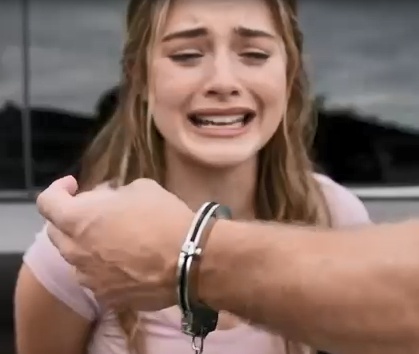
By the time I opened the door, my nineteen-year-old daughter was standing beside her mother’s SUV with grocery bags spilled around her feet, a carton of eggs broken across the driveway, one wrist twisted behind her back, and a pair of steel handcuffs clamped so tightly around her skin that her fingers were already swelling.
Three men stood around her.
Black sleeveless tactical jackets.
Plastic badges.
Fake authority written all over them.
The man holding the cuff key was smiling.
His name tag read:
SHEFFIELD
ENFORCEMENT CAPTAIN
He had a muscular build, cold eyes, and the relaxed confidence of someone who had frightened people before and expected it to work again.
Behind him stood a shorter red-haired man with a clipboard.
KOWALSKI
COMPLIANCE OFFICER
The third man was older, gray-haired, heavy through the shoulders, holding a tablet like it was a warrant.
PETROV
FIELD OFFICER
Their unmarked silver Silverado was parked crookedly at the curb, angled like a police vehicle blocking a scene. But there were no blue lights. No department markings. No uniforms. No real badges. No lawful power.
Only my daughter crying in my driveway while a stranger dangled a key in front of her pain.
My name is Adam Whitaker. I am forty-seven years old. I have practiced criminal defense law in North Carolina for eighteen years. I have represented people accused of assault, kidnapping, fraud, false imprisonment, extortion, burglary, impersonating officers, domestic violence, armed robbery, and almost every kind of crime that begins with one person deciding another person’s rights do not matter.
I know unlawful restraint when I see it.
I know coercion when I hear it.
I know extortion when someone wraps it around a threat.
And standing in my own doorway, watching my daughter’s wrist turn purple under a pair of handcuffs, I knew exactly what those men were doing.
They were not enforcing anything.
They were performing power.
They had picked a girl unloading groceries, slapped cuffs on her, hurt her, and expected the father to either panic, pay, or lose control.
That was their mistake.
A father’s rage is dangerous.
A lawyer’s rage is worse when he keeps it organized.
I stepped onto the driveway with my phone already in my hand.
“Take those cuffs off my daughter right now.”
Emma turned toward me, tears streaming down her face.
“Dad, I just asked what they were doing here. He grabbed me. I didn’t do anything.”
Sheffield’s smile did not move.
“Your daughter interfered with an official HOA inspection,” he said. “She refused a lawful order. She is being detained until we complete our assessment and receive payment for outstanding violations.”
I stopped three feet from him.
Close enough for him to hear me clearly.
Far enough that no one could claim I touched him.
“There is no HOA in this neighborhood.”
Kowalski lifted the clipboard like a shield.
“This property has twelve thousand dollars in outstanding Brookfield HOA violations. Unapproved landscaping. Unauthorized driveway modifications. Failure to submit architectural review forms. Noncompliant exterior storage. Obstruction of enforcement activity.”
I looked at him.
“Brookfield has no HOA. I verified that before I bought this house.”
Petrov turned his tablet toward me. On the screen was a document with a fake county seal and a list of supposed violations.
“This section was annexed into Brookfield HOA last month,” he said. “Notice was issued. Your property is now subject to enforcement authority.”
Emma whimpered and tried to shift her weight.
The cuff cut deeper.
I saw a thin line of blood at her wrist.
My vision narrowed for half a second.
Only half.
Then training took over—not military training, not police training, but courtroom training. The kind that teaches you that if you want someone destroyed legally, you do not interrupt them too soon. You let them finish building the record.
I raised my phone and began recording.
“This is Adam Whitaker at 847 Ashford Lane,” I said, keeping my voice steady. “Three men in tactical vests are on my private property claiming false HOA authority. One of them has handcuffed my nineteen-year-old daughter without lawful authority. She is injured. They are demanding money.”
Sheffield’s eyes flicked to the phone.
“Recording enforcement personnel without consent is another violation.”
“No,” I said. “It’s evidence.”
His jaw tightened.
“Your daughter stays detained until you cooperate.”
“Say that again.”
He hesitated.
The smile slipped.
I took one step closer, still not touching him.
“You are using physical restraint to force payment of an alleged debt. That is not HOA enforcement. That is extortion. That is false imprisonment. That is assault and battery. And every second those cuffs remain on my daughter increases your exposure.”
Kowalski shifted his weight.
Petrov glanced toward the truck.
Sheffield tried to reclaim the scene by lifting the key.
“Maybe if you pay the twelve thousand dollars, we can discuss releasing her.”
Emma sobbed.
That was enough.
I dialed 911.
## BODY
“911. What is your emergency?”
“I need police and medical response at 847 Ashford Lane in Brookfield,” I said. “Three men are trespassing on my property. They have handcuffed my daughter. They are claiming fake HOA authority and demanding payment. My daughter is injured.”
The operator asked whether weapons were visible.
“I do not see firearms,” I said. “One subject has the cuff key. Three adult males. Black sleeveless tactical vests. Unmarked silver Silverado. My daughter is nineteen, restrained, crying, and injured.”
Sheffield stepped toward me.
“You just made this worse.”
I kept the phone between us.
“No. You did that when you put hands on her.”
Kowalski began writing on his clipboard.
“Additional violation. Harassment of enforcement personnel. Refusal to permit inspection. Interference with HOA officer duties.”
I almost laughed. Not because any of this was funny, but because I had cross-examined better liars on misdemeanor calendars before lunch.
“You are not officers,” I said.
Petrov said, “You’ll regret that statement when foreclosure begins.”
“Good. Say foreclosure clearly for the recording.”
He stopped.
There it was again.
The awareness.
These men were not confused volunteers. They knew what words sounded frightening. They knew which threats made homeowners panic. They knew how to look official enough to buy themselves time.
But they did not know my world.
They did not know that every sentence they spoke could become an exhibit.
They did not know that my brain was already arranging charges in neat columns.
False imprisonment.
Assault.
Battery.
Extortion.
Criminal impersonation.
Conspiracy.
Fraud.
Attempted theft by deception.
Possession of forged instruments.
Possible kidnapping enhancement depending on state interpretation and restraint facts.
Civil claims.
Punitive damages.
Medical documentation.
Emotional distress.
Attorney fees.
I knew the road.
They were walking themselves down it.
“Dad,” Emma whispered. “Please make him take them off.”
I turned slightly toward her.
“Sweetheart, listen to me. Don’t pull against the cuff. Keep your fingers moving if you can. Help is coming. I’m right here.”
“It burns.”
“I know.”
Sheffield rolled his eyes.
That one small movement nearly broke my restraint.
I felt it. The heat in my chest. The old animal part of me that did not care about courtrooms, records, or procedure. The father part. The part that wanted to put Sheffield on the pavement and make him understand pain without legal terminology.
But he wanted that.
I saw it then.
He wanted me to swing.
If I hit him, he could claim the homeowner attacked official enforcement. If I shoved him, he could muddy the record. If I threatened him, he could pretend his restraint of Emma had been justified by the father’s aggression.
So I gave him nothing.
Nothing except the camera.
Nothing except my voice.
Nothing except the law closing around him one word at a time.
The first patrol car arrived in under seven minutes.
The second came right behind it.
Two Charlotte-Mecklenburg officers stepped out fast but controlled. The lead officer was Sergeant Miguel Torres, a compact man with careful eyes and the kind of command presence that does not need volume. Officer Jackson, younger and taller, came around the second car.
I lifted one hand.
“I’m the caller. Adam Whitaker. That man has my daughter in handcuffs. He has no lawful authority.”
Torres looked at Emma first.
That told me he was good.
Her wrist was swollen, bruised, and bleeding.
His expression changed.
Then he looked at Sheffield.
“Remove the cuffs now.”
Sheffield straightened.
“Sergeant, we are Brookfield HOA Enforcement. We are conducting a lawful compliance inspection. This individual interfered with official duties.”
Torres did not blink.
“You have no authority to handcuff anyone. Remove them now.”
“She is detained pending—”
Torres’s voice sharpened.
“Now.”
Sheffield looked around, calculating.
For the first time, the confidence was not enough.
He unlocked the cuffs.
Emma collapsed into me the second her wrist came free. I caught her with one arm while keeping my phone recording with the other.
Her wrist was worse than I feared.
The cuff had cut into the skin. Her hand shook uncontrollably. A dark bruise was already rising under the broken skin.
Officer Jackson called for an ambulance.
Torres turned to Sheffield.
“Hands where I can see them.”
Sheffield’s face hardened.
“This is a misunderstanding.”
“No,” I said. “This is recorded.”
I handed Torres my phone.
He watched the video right there in the driveway.
The fake enforcement claims.
The dangling key.
The demand for payment.
Emma crying.
The refusal to release her.
By the time the video reached Sheffield saying, “Maybe if your dad cooperates and pays,” Torres’s mouth had become a hard line.
“Mr. Sheffield,” he said, “you are being detained pending investigation for assault, unlawful restraint, and extortion.”
Kowalski started talking immediately.
“I didn’t touch her. I was just documenting compliance issues.”
Petrov took one step backward toward the Silverado.
Officer Jackson saw it.
“Stop.”
Petrov stopped.
Torres radioed for a supervisor and detectives.
Within twenty minutes, my quiet residential street looked like a crime scene. Neighbors stood at windows. Paramedics treated Emma in the driveway, then moved her into the ambulance for further evaluation. My wife arrived from the grocery store and nearly dropped her keys when she saw Emma’s wrist wrapped in gauze.
“What happened?”
I told her.
She looked at Sheffield in handcuffs.
Not fake handcuffs.
Real ones.
For a moment, I thought she might do what I had refused to do.
I stepped in front of her gently.
“Let the police have him.”
Her eyes filled with tears and fury.
“He hurt our child.”
“I know.”
“Adam.”
“I know.”
And because I knew, I was going to make sure he could not talk his way out of it.
Detective Marissa Harris from major crimes arrived less than an hour later.
Major crimes.
That mattered.
The case had already moved past neighborhood nonsense.
Harris was in her early forties, composed, direct, with a voice that told people she preferred facts but did not mind pressure. She listened to Torres, reviewed my video, examined the fake documents, and ordered the Silverado searched.
What they found turned Sheffield’s driveway performance into an organized criminal case.
Multiple sets of handcuffs.
Zip ties.
Forged HOA notices.
Fake county filings.
A portable payment processor.
A tablet loaded with violation templates.
A binder listing target properties.
Notes on homeowners.
Work schedules.
Family members.
Fear points.
One page had my address.
ADAM WHITAKER
Attorney
Likely argumentative
Daughter home mornings?
Use obstruction pressure if available
Demand immediate payment before police involvement
I read that line later in Detective Harris’s office, and it made my blood go cold.
Daughter home mornings?
They had not accidentally cuffed Emma.
They had planned to use whoever was vulnerable.
If Emma had not been outside, maybe they would have tried my wife. If my wife had not been home, maybe they would have cornered a neighbor. The target was not just property. It was leverage.
Detective Harris looked across the table at me.
“This is not their first time.”
“How many?”
“We have open complaints from several neighborhoods. Fake HOA enforcement. Threats. Demands for immediate payment. At least six reports of young women being restrained or physically blocked during these encounters.”
“Restrained how?”
“Handcuffs in three confirmed cases before today. Possibly more.”
I closed my eyes for one second.
Seven women, counting Emma.
Seven.
That number changed my anger into something colder.
“Detective,” I said, “I want every possible charge.”
“We intend to pursue this aggressively.”
“I’m a criminal defense attorney. I know what aggressive means on paper and what it means in practice. I want the district attorney to understand the pattern. This is not a paperwork scam. It is physical coercion.”
Harris nodded.
“I agree.”
“I want medical documentation preserved. I want the cuffs tested. I want the payment device traced. I want every forged filing connected. I want every victim interviewed again.”
“You’re not the prosecutor, Mr. Whitaker.”
“No,” I said. “I’m the father. And I know how cases fall apart when people call violence a misunderstanding.”
She studied me for a moment.
Then she said, “This one won’t.”
Emma needed twelve stitches.
The ER doctor documented deep abrasions, bruising, swelling, and nerve irritation consistent with prolonged tight restraint. Photographs were taken before and after treatment. Measurements were added to the chart. The doctor noted that the handcuffs had been applied with excessive pressure.
I watched Emma sit on the hospital bed, pale and exhausted, her wrist bandaged, her eyes fixed on the floor.
“I should have just gone inside,” she said.
“No.”
“If I hadn’t asked them—”
“No.”
She looked at me.
I pulled a chair closer.
“Listen carefully. You did not cause this. Asking why strangers are on your property is normal. Handcuffing you is criminal. They did this because they are predators, not because you made a wrong choice.”
Tears spilled down her face.
“I was so scared.”
“I know.”
“I hated that he was laughing.”
My hands tightened together.
“I know.”
“Are they going to get away with it?”
“No,” I said.
And I meant it in a way I have rarely meant anything.
DA Michelle Parker called me three days later.
“I reviewed the preliminary evidence,” she said. “This is worse than the first report suggested.”
“Yes.”
“We are charging Sheffield, Kowalski, and Petrov with assault, battery, false imprisonment, extortion, criminal impersonation, conspiracy, fraud, and possession of forged instruments. We are also reviewing aggravating factors based on victim targeting.”
“They targeted young women.”
“That is what the evidence appears to show.”
“Then say it. In court.”
“We will.”
Over the next eight months, the case grew.
Detective Harris found victims in eight neighborhoods.
No Brookfield HOA existed.
No annexation had been filed.
The fake documents were traced to Kowalski’s laptop.
Petrov had created shell mailing addresses.
Sheffield had purchased the handcuffs and tactical gear.
Their payment processor account showed over $90,000 in fake fines collected in less than a year.
Some families paid because they feared foreclosure.
Some paid because they feared arrest.
Some paid because their daughters, wives, or sisters had been touched, blocked, cuffed, or threatened.
Several had never reported the incidents because Sheffield told them calling police would add charges for “interfering with enforcement personnel.”
That phrase appeared in their scripts.
Scripts.
That was what made the case even uglier.
They had written out the intimidation.
They had trained themselves to sound official while committing crimes.
Emma struggled in the months before trial.
The physical wound healed. The scar remained. The nerve pain faded slowly. But certain sounds could still freeze her: keys snapping on a belt loop, metal clicking, a man laughing too loudly in a parking lot.
She hated that.
“I feel weak,” she told me one night.
We were sitting in the kitchen. Her mother had gone to bed. The house was quiet.
“You are not weak.”
“I keep hearing the cuffs.”
“That is trauma, not weakness.”
“I hate that word.”
“I know.”
“I hate that he gets to be in my head.”
I leaned forward.
“He doesn’t get to stay.”
She looked at me.
“How do you know?”
“Because you’re already fighting him.”
“I don’t feel like I am.”
“You gave a statement. You let doctors document the injury. You agreed to testify. You’re still going to class. You still came home. You’re sitting here talking about it instead of letting shame silence you.”
She looked down at the scar on her wrist.
“I want him to have to look at it.”
“He will.”
The trial began in late spring.
The courtroom was packed.
Victims filled the benches. Parents sat beside daughters. A few reporters sat along the side wall. Sheffield, Kowalski, and Petrov sat at the defense table in suits that made them look smaller than they had in the driveway.
Without the vests, they were just men.
That was the first crack in the illusion.
The prosecutor opened with my video.
The jury watched Emma crying.
They watched Sheffield holding the key.
They heard him say she would stay detained until we cooperated.
They heard the demand for money.
They watched Sergeant Torres arrive and order him to remove the cuffs.
Then the prosecutor paused on the image of Sheffield’s fake badge.
“This badge,” DA Parker said, “had no lawful power. But the defendants used it to make people believe they had no choice. That is the core of this case. Fake authority, real fear, real injury, real money.”
The defense tried to call it confusion.
A civil dispute.
A mistaken belief in an HOA boundary expansion.
Overzealous collection activity.
Every phrase sounded worse than the last.
Emma testified on the third day.
She wore a navy blazer and left her wrist uncovered.
I sat behind her, not as counsel, but as her father.
The prosecutor asked what happened.
Emma told the jury everything.
The groceries.
The strangers.
The question she asked.
Sheffield grabbing her arm.
The cuff tightening.
The pain.
The key dangling.
The humiliation.
The fear.
Then the prosecutor asked, “What did you believe would happen if your father did not pay?”
Emma looked at the jury.
“I believed he would keep hurting me.”
The courtroom went silent.
On cross-examination, Sheffield’s lawyer tried to suggest Emma had misunderstood the situation.
“Ms. Whitaker, you were upset, correct?”
“Yes.”
“You were crying?”
“Yes.”
“You were frightened?”
“Yes.”
“So your memory of the details may not be perfect.”
Emma looked at him.
“My memory of pain is very clear.”
The lawyer paused.
“You are not a legal expert, correct?”
“No.”
“So you cannot personally testify whether my client believed he had authority.”
“No,” Emma said. “But I can testify that real authority does not laugh when someone says the cuffs are cutting them.”
That sentence landed like a verdict before the verdict.
The defense attorney sat down soon after.
The other victims testified.
Claire, who had been cuffed in her parents’ garage.
Maya, who had been blocked in a driveway.
Lena, whose family had paid thousands after Petrov threatened a fake lien.
A young nurse who said Sheffield told her she “looked like someone who needed rules explained the hard way.”
Each story made the pattern clearer.
They did not enforce.
They hunted.
Detective Harris testified about the binder.
The target notes.
The fake documents.
The payment records.
The handcuffs.
The shell company.
The scripts.
Then I testified.
The prosecutor asked about my background, the property, the lack of HOA, my recording, my call to 911, my legal understanding of what I saw, and the statements Sheffield made.
The defense attorney tried to use my profession against me.
“Mr. Whitaker, you are a criminal defense attorney.”
“Yes.”
“You understand how to frame events in criminal language.”
“I understand crimes when I see them.”
“You were angry.”
“Yes.”
“You wanted these men punished.”
“Yes.”
“So you had a motive to make this sound worse than it was.”
I looked at him.
“My daughter’s wrist required twelve stitches. The video speaks for itself.”
He tried again.
“You did not physically intervene.”
“No.”
“Why?”
“Because that is exactly what they wanted.”
He stopped.
I continued before he could.
“They wanted me to lose control so they could pretend the restraint was justified. I chose evidence over emotion.”
The prosecutor did not need much more.
The jury deliberated for three hours.
Guilty.
All major counts.
Sheffield’s face went empty.
Kowalski cried.
Petrov stared at the table as if he could disappear into it.
Emma’s hand found mine.
This time, she was not shaking.
## ENDING
Sentencing day was the day Sheffield’s fake badge died.
Not metaphorically.
Publicly.
Completely.
The courthouse hallway was full before nine in the morning. Victims stood with families. Reporters waited near the doors. Detective Harris spoke quietly with DA Parker. Sergeant Torres stood near the back wall in uniform, the same officer who had ordered Sheffield to take the cuffs off Emma in my driveway.
Emma stood beside me in a dark blazer, her scar uncovered.
She had chosen that deliberately.
“I want him to see it,” she said.
Inside the courtroom, DA Parker had arranged the evidence table with brutal simplicity.
The black tactical vest.
The fake plastic badge.
The forged Brookfield HOA documents.
The fake violation forms.
The tablet.
The payment processor.
The notebook of targets.
And the handcuffs.
The same handcuffs.
They sat sealed in a clear evidence bag, small and ordinary under the courtroom lights.
Emma looked at them and inhaled sharply.
“You okay?” I whispered.
“No,” she said. “But I’m ready.”
Sheffield was brought in wearing jail clothes.
No vest.
No badge.
No title.
No swagger.
Just a defendant in custody, wrists restrained by real deputies with real authority.
When his eyes landed on the evidence table, his face changed.
For the first time since I had met him, he looked exposed.
Not sorry.
Exposed.
Judge Maren Caldwell took the bench.
The courtroom rose.
She read the case number, the convictions, and the purpose of the hearing. Her voice was calm, but there was no softness in it.
DA Parker stood.
“Your Honor, the state asks to present victim impact statements.”
“Proceed.”
Claire went first.
She stood at the podium and told Sheffield how he had cuffed her in her parents’ garage and made her believe her family would lose their home.
Then she looked directly at him.
“You are not enforcement. You are not a captain. You are not an officer. You are a criminal who needed a fake badge to feel powerful.”
Sheffield looked down.
Judge Caldwell leaned forward.
“Mr. Sheffield, you will look at the speaker.”
His face tightened.
But he obeyed.
One by one, the victims spoke.
The nurse.
The mother.
The student.
The woman whose father paid fake fines.
The young homeowner who still could not park in her driveway without remembering Petrov blocking her path.
Each statement stripped something from him.
The fake badge had made him seem large in driveways and garages.
In court, listening to the women he had hurt, he became smaller with every word.
Then Emma stood.
The courtroom seemed to hold its breath.
She walked to the podium alone.
I stayed seated because she had asked me to.
“I need to stand by myself,” she told me that morning.
So I let her.
Her hands rested on the podium. The scar on her wrist was visible.
She looked at Sheffield.
“You put handcuffs on me in my own driveway,” she said. “I was carrying groceries. I asked what you were doing on our property. You grabbed me, twisted my arm, and locked metal around my wrist so tightly it cut into my skin.”
Sheffield stared at the table.
The judge’s voice came down hard.
“Mr. Sheffield.”
He raised his head.
Emma continued.
“I told you it hurt. You laughed. You dangled the key in front of me. You told my father maybe you would let me go if he paid you.”
Her voice shook once.
Then steadied.
“You wanted me afraid. You wanted my dad angry. You wanted our family confused enough to give you money. You thought that badge made you powerful.”
She lifted her wrist.
“This scar is real.”
Then she pointed toward the fake badge on the evidence table.
“That badge is not.”
No one moved.
Not the reporters.
Not the deputies.
Not even Sheffield.
Emma’s voice grew stronger.
“I used to think courage meant not being scared. Now I know courage is standing here while the man who hurt you has to listen. Courage is telling the truth when your voice shakes. Courage is looking at the thing that hurt you and saying it does not get to own the rest of your life.”
My throat tightened so hard I could barely breathe.
Emma looked at Judge Caldwell.
“I do not want him punished only for what he did to me. I want him punished for every woman he touched, every family he threatened, every fake paper he used, every dollar he stole, and every time he made someone think cruelty was authority.”
Then she turned back to Sheffield.
“You failed.”
Two words.
That was all.
But they landed harder than any argument I had made in eighteen years of courtrooms.
Sheffield had no answer.
DA Parker rose after Emma returned to her seat.
“Your Honor,” she said, “the state asks for the maximum sentence. These defendants did not make a mistake. They built a system. They forged authority, selected victims, used physical restraint, demanded payment, and hid behind a fake HOA to make crime look official.”
She picked up the plastic badge.
It looked cheap in her hand.
Almost pathetic.
“This badge never had legal power,” she said. “But Brandon Sheffield used it with handcuffs, threats, and fear. That combination turned plastic into a weapon.”
She placed it beside the cuffs.
“Fake authority does not become real because a victim is frightened enough to obey.”
Sheffield’s attorney stood and tried to ask for leniency.
He spoke about difficult circumstances, bad judgment, financial pressure, and the possibility of rehabilitation.
Then he made the mistake of saying, “Mistakes were made.”
Judge Caldwell interrupted him.
“Mistakes?”
The courtroom went cold.
The defense attorney swallowed.
“Poor decisions, Your Honor.”
The judge’s eyes hardened.
“Counsel, your client did not accidentally mail a notice to the wrong address. He handcuffed a young woman without lawful authority, injured her, and used her restraint to demand money. Choose your language carefully.”
The attorney sat down soon after.
Then Sheffield asked to speak.
His lawyer looked alarmed, but the judge allowed it.
Sheffield stood slowly.
For once, he had no performance ready.
“I never meant for anyone to get seriously hurt,” he said.
Emma went still beside me.
“I thought the HOA documents gave us—”
DA Parker stood.
“Objection. Continued false justification.”
“Sustained,” Judge Caldwell said.
Sheffield tried again.
“I’m sorry people got hurt.”
Judge Caldwell leaned forward.
“People did not get hurt, Mr. Sheffield. You hurt them.”
He said nothing.
“You may sit.”
That was his apology.
Empty.
Forced.
Worthless.
Judge Caldwell began sentencing with a statement I will remember for the rest of my life.
“Authority is one of the most dangerous things a person can imitate,” she said. “Citizens are taught to respect badges, notices, official language, and lawful instructions. Society depends on that trust. The defendants exploited it.”
She looked from Sheffield to Kowalski to Petrov.
“You used fake documents, fake titles, fake fines, fake legal threats, and fake enforcement powers. But the injuries were real. The fear was real. The money taken was real. The restraint was real.”
Then she looked at Sheffield.
“You personally placed handcuffs on multiple victims. In Emma Whitaker’s case, you tightened those cuffs enough to cut her skin, then used her pain as leverage against her father.”
The courtroom was silent.
“You called yourself Enforcement Captain,” the judge said. “This court calls you a violent extortionist.”
Sheffield flinched.
There it was.
The word no fake badge could cover.
Violent extortionist.
Then the sentence came.
Brandon Sheffield: fifteen years in state prison.
David Kowalski: thirteen years.
Alexei Petrov: twelve years.
Full restitution to every victim.
Medical expenses.
Therapy costs.
Refund of fake payments.
Punitive damages preserved for civil court.
All forged HOA documents voided.
All fake filings expunged.
All payment accounts seized.
The shell company dissolved.
No contact with any victim.
Permanent prohibition from security, enforcement, property management, debt collection, or compliance-related work after release.
Then came the final humiliation.
Judge Caldwell looked at the evidence table.
“The court orders the fake badge, tactical vest, forged documents, target notebook, and handcuffs retained by the district attorney’s office for training purposes in cases involving false authority, unlawful restraint, extortion, and impersonation.”
Sheffield’s head snapped up.
That hurt him more than I expected.
The prison sentence scared him.
But this humiliated him.
His badge would not disappear.
It would not be hidden away.
It would sit in a training display as an example of fake power exposed by real law.
Judge Caldwell delivered the final words slowly.
“Let the record show clearly: Brookfield HOA Enforcement never existed. These defendants had no lawful authority. Their badge was fake. Their documents were fake. Their power was fake. Their crimes were real.”
The gavel came down.
And that was the sound of his fake badge dying.
Deputies moved in.
This time, the handcuffs were real.
Sheffield turned as they cuffed him. His eyes found Emma.
Maybe he wanted to frighten her one last time.
Maybe he wanted to see the girl from the driveway cry again.
She did not.
She stood.
Slowly.
Then she lifted her scarred wrist just enough for him to see it.
Not as a wound.
As proof.
Sheffield looked away first.
That was the moment I knew we had won completely.
Not because he was going to prison.
Not because the judge had condemned him.
Not because the cameras were outside.
Because the daughter he tried to reduce to fear had become the last person in the room he could not face.
Outside the courtroom, reporters gathered near DA Parker.
She gave a short statement.
“This case proves that fake authority is not a loophole. It is a crime. When criminals use forged documents, false badges, and physical restraint to extort families, they will be prosecuted aggressively.”
A reporter asked Emma if she felt justice had been done.
Emma looked at the other victims first.
Then at me.
“Yes,” she said. “But justice should teach people what to watch for.”
That sentence ran on the evening news.
The next week, the county recorder’s office published a public guide explaining how homeowners could verify HOA covenants, liens, filings, and enforcement authority. Charlotte-Mecklenburg police issued a warning about fake HOA scams. The district attorney’s office began using Sheffield’s case in training sessions. The local bar association asked me to speak about false authority crimes.
Emma came with me.
The first time, she sat in the front row and said nothing.
The second time, she stood beside me.
She looked at a room full of homeowners and said, “Real authority can be verified. Real authority has limits. Real authority does not need to hurt you for fun.”
People stood for her.
Not because she was a victim.
Because she was no longer only that.
The civil case followed.
We sued Sheffield, Kowalski, Petrov, and the shell company behind the fake HOA operation. The judgment covered medical expenses, emotional trauma, punitive damages, fraud, false imprisonment, assault, and attorney fees. Their seized accounts paid part of it. Victim compensation covered therapy. Their fake HOA website was taken down. Their mailing address was closed. Their documents were stamped void. Their names became permanent public records tied to the scam they had tried to hide behind.
One year after sentencing, DA Parker sent Emma a photograph.
In it, Sheffield’s fake badge sat behind glass beside the handcuffs and one forged violation notice.
Underneath was a label:
STATE v. SHEFFIELD
FALSE HOA ENFORCEMENT / UNLAWFUL RESTRAINT / EXTORTION
FAKE AUTHORITY DOES NOT CREATE LEGAL POWER
Emma stared at the photograph for a long time.
Then she smiled.
Not happily.
Peacefully.
“Good,” she said. “Let it teach.”
Six months later, she walked into my office and placed a law school acceptance letter on my desk.
I read it twice.
“You’re sure?” I asked.
“I’m sure.”
“You don’t have to turn pain into a career.”
“I’m not,” she said. “I’m turning it into a weapon for people who need one.”
I had no argument for that.
Today, Sheffield is still in prison.
So are Kowalski and Petrov.
Their fake HOA is gone.
Their shell company is dissolved.
Their forged documents are void.
Their accounts are seized.
Their victims have restitution orders.
Their fake badge is no longer a threat.
It is a lesson.
And Emma is in law school, studying civil rights and criminal procedure, learning how to stand between people and the kind of power that pretends to be lawful because it knows fear can make lies look official.
That is the ending.
Not a punch in the driveway.
Not blind revenge.
Not a father losing control and giving Sheffield the excuse he wanted.
The real ending is stronger.
A clean video.
A brave witness.
A courtroom full of victims.
A judge who named the crime.
A fake badge stripped of meaning.
A predator led away in real cuffs.
And my daughter standing tall enough to make him look down.
Sheffield cuffed Emma because he thought pain would make us pay.
Instead, pain became evidence.
Evidence became conviction.
Conviction became prison.
And the handcuffs that began on my daughter’s wrist ended exactly where they belonged.
On him.