PART 2
She hated vehicles parked too long in the same place, even when the street was public and the county had no issue with it. She called ordinary parked cars “visual clutter.” She called pickup trucks “commercial blight.” She once referred to a teenager’s dusty Jeep as “a threat to neighborhood reputation.”
My Camry became her favorite target because it offended her imagination.
It was plain.
It was quiet.
It did not move on her schedule.
Sometimes I parked it in my driveway. Sometimes I parked it on the street overnight when my personal truck blocked the garage or when I came home late from surveillance and did not feel like shuffling vehicles at two in the morning.
The vehicle was registered, insured, maintained, and legally parked.
Karen did not care.
The first notice appeared under the windshield wiper on a Monday morning.
UNIDENTIFIED VEHICLE PARKED FOR EXTENDED PERIOD.
MOVE IMMEDIATELY OR VEHICLE WILL BE TOWED UNDER HOA ABANDONED VEHICLE POLICY.
I read it while holding a cup of coffee and almost laughed.
Almost.
Then I checked the governing documents.
There was a rule about inoperable vehicles on private lots.
There was a rule about vehicles leaking fluids in driveways.
There was a rule about trailers, RVs, and commercial vehicles.
There was no authority over legally parked, operable passenger vehicles on county-maintained streets.
Karen had invented authority where none existed.
That never ends well.
I moved the Camry into my driveway that day, not because she was right, but because I had no interest in starting a fight over a parking notice. My work already gave me enough conflict. I did not need suburban drama.
But Karen mistook restraint for weakness.
A week later, she left another notice.
Then an email.
Then a certified letter claiming the Camry was “suspicious, abandoned, unattractive, and inconsistent with community standards.”
Suspicious and abandoned at the same time.
That was Karen logic.
I responded once.
Short.
Professional.
Ms. Whitmore,
The vehicle is registered, operable, insured, and legally parked. The street is county property. The HOA has no towing authority over lawful street parking absent a legitimate safety issue or statutory authorization. Do not interfere with the vehicle.
Tony Delgado.
She replied within six minutes.
Mr. Delgado,
The board has broad enforcement authority to protect the visual and safety interests of Silver Springs residents. Failure to comply will result in escalation.
Karen Whitmore
HOA President
Broad enforcement authority.
Another phrase people use when they cannot cite an actual rule.
I forwarded the exchange to the real HOA management company and saved a copy. Then I let it go.
For a while.
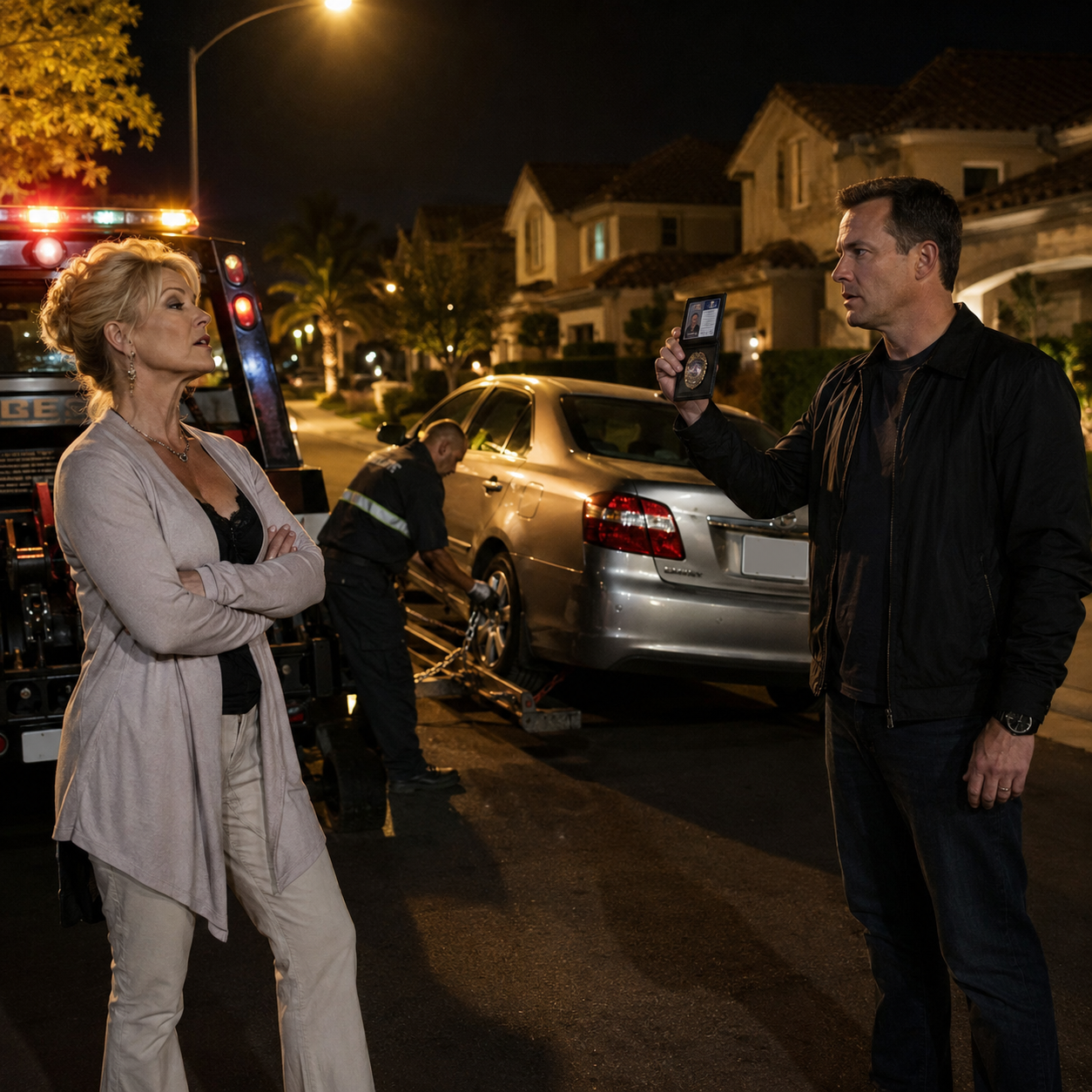
Three weeks later, I was assigned to a long surveillance operation tied to a public corruption case. The kind of case that required late nights, clean vehicles, patience, and enough coffee to make my doctor sigh. For three consecutive nights, I returned home after one in the morning, parked the Camry on the street, went inside, slept badly, and left again.
On the third night, I pulled onto my street at 1:45 a.m.
The space where the Camry had been parked was empty.
At first, my brain rejected it.
Vehicles get stolen.
Vehicles get moved.
Vehicles get towed.
But this vehicle was not a normal personal car. It was federal property assigned for law enforcement operations. Even without sensitive equipment inside overnight, any unauthorized access mattered.
I parked my truck in the driveway and walked to the curb.
No broken glass.
No tire marks from a theft.
No note.
I called Las Vegas Metropolitan Police non-emergency first, because if a vehicle has been towed legally, dispatch will often know before you start assuming worse.
The dispatcher checked.
“Yes, sir. That vehicle was towed by Desert Auto Recovery at the request of Riverbend HOA for abandoned vehicle enforcement.”
I closed my eyes.
“Silver Springs HOA?”
“Yes, sir. Request made by Karen Whitmore.”
My hand tightened around the phone.
“Can you give me the tow yard address?”
She did.
I drove there immediately.
Desert Auto Recovery sat behind a chain-link fence under harsh industrial lights, the kind of place where cars looked guilty even when they were victims. A man behind bulletproof glass slid paperwork through a slot and told me the release fee was $350.
I paid.
Not because Karen was right.
Because the first priority was recovering the vehicle.
Always secure the asset first.
Fight the invoice later.
When they brought the Camry around, I did what I always do before getting into a work vehicle after it has been outside my control.
Security check.
Exterior.
Door seams.
Locks.
Windows.
Tires.
Undercarriage visual.
Interior through glass.
Then I saw the driver’s door lock.
Scratches.
Fresh.
Thin, curved marks near the seal.
Not tow-hook damage.
Not normal wear.
Tool marks.
Someone had opened the door.
I unlocked the vehicle, put on gloves from my truck, and checked the interior.
The glove box was open.
The center console papers had been moved.
The sun visor was down.
The rear floor mat was shifted.
Someone had searched the car.
My anger went cold.
That is different from hot anger.
Hot anger makes people shout.
Cold anger builds a chain of custody.
I drove the Camry home, parked it in my garage, closed the door, and called my supervisor.
Special Agent in Charge Rebecca Harlan answered on the second ring.
“This better be important, Tony.”
“It is. My unmarked unit was towed by my HOA president tonight. When I recovered it, I found signs of forced entry and interior search.”
A beat of silence.
“Was any operational equipment compromised?”
“No sensitive equipment left inside overnight. But someone accessed a federal law enforcement vehicle without authorization.”
“Secure the vehicle. Do not touch anything else. Call Metro. I’m sending evidence response.”
“Already in the garage.”
“Good. Tony?”
“Yes?”
“Do not handle this like a neighborhood dispute.”
“I won’t.”
I called Metro and filed the report.
Then I checked my home security footage.
My cameras covered my driveway and part of the street where the Camry had been parked. The angle was not perfect, but it was good enough.
At 2:08 a.m., Karen’s white Lexus rolled up.
She got out wearing athletic clothes, a jacket, and gloves.
Gloves.
At 2:09, she walked around the Camry with her phone, photographing it from every angle.
At 2:10, she tried the door handles.
At 2:11, she went back to her Lexus, opened the rear passenger door, and returned with a thin metal tool.
At 2:12, she worked the tool along the driver’s side window seal.
At 2:14, the door opened.
At 2:14 to 2:19, Karen leaned inside my unmarked FBI unit with a flashlight, opened compartments, shifted papers, photographed the interior, and looked under the front seat.
At 2:20, she closed the door.
At 2:15—according to the timestamp from another angle—the tow truck arrived and waited while she finished.
At 2:22, the Camry was hooked.
At 2:27, it was gone.
I watched the footage three times.
Not because I needed to.
Because each viewing made the case stronger in my head.
This was not a mistaken tow.
This was not overzealous enforcement.
This was forced entry into federal property.
And Karen had filmed herself committing the crime with my camera doing the same thing from a better angle.
PART TWO — FEDERAL PROPERTY DOES NOT CARE ABOUT HOA LETTERHEAD
Detective Harrison from Metro arrived the next morning.
He was a calm man with a slow voice and sharp eyes, the kind of detective who did not waste words because he understood evidence usually spoke better.
I showed him the Camry first.
He photographed the lock, the door seal, the glove box, the console, and the interior disturbance. Then we watched the video in my kitchen.
Karen appeared on the screen.
White Lexus.
Phone.
Door handles.
Tool.
Forced entry.
Flashlight.
Interior search.
Tow truck.
Harrison leaned back.
“Well,” he said, “that is not ambiguous.”
“No.”
“She used a tool to open the vehicle.”
“Yes.”
“Then searched it.”
“Yes.”
“And this is assigned federal law enforcement property.”
“Yes.”
He exhaled.
“State charges are obvious. Vehicle burglary. Tampering. Criminal mischief. The federal side is going to be ugly for her.”
“Rebecca is coordinating with the U.S. Attorney’s Office.”
“Good.”
The FBI evidence response team arrived before noon.
That was when the neighborhood started paying attention.
Two federal vehicles parked in my driveway.
Evidence techs in gloves.
Photographs.
Print lifts.
Lock examination.
Interior swabs.
Documentation.
People slowed down when passing my house.
By lunchtime, the Silver Springs Facebook group had thirty-seven comments asking why the FBI was at Tony Delgado’s place.
Karen posted nothing.
That was the first sign she knew something had gone wrong.
By evening, Rebecca called.
“The U.S. Attorney’s Office wants the full package. Video, ERT report, your statement, Metro report, tow company records, HOA correspondence.”
“They’re taking it?”
“They are interested.”
In federal language, interested means someone is already sharpening a knife.
The tow company records made Karen look worse.
Desert Auto Recovery had no independent complaint. Karen personally called and claimed the Camry was abandoned, suspicious, and subject to HOA removal. She signed the authorization as HOA president. She represented that the HOA had legal authority. She also wrote in the notes:
Vehicle interior checked prior to tow. No owner identifying materials visible.
Interior checked.
She put that in writing.
That meant she was not going to be able to claim she never entered.
The tow company owner, a tired man named Dale Mercer, cooperated immediately.
“We don’t break into cars,” he told Detective Harrison. “We tow when authorized. If she opened it, that was her.”
“Did you ask her to open it?”
“No.”
“Did your driver?”
“No. Driver said she was already messing with it when he got there.”
The driver confirmed that.
He had assumed Karen owned the vehicle or had authority because she was the HOA president.
That sentence became a theme.
Because she was the HOA president.
People had let Karen do things because of a title.
A title is not a warrant.
A title is not consent.
A title does not turn a private vehicle into community property.
Three days later, federal agents and Metro officers knocked on Karen’s door at 6:03 a.m.
I was not part of the arrest team. I could not be. I was the victim and a witness.
But I saw enough from my front window.
Two unmarked federal vehicles.
One Metro unit.
Agents at Karen’s front door.
The white Lexus in the driveway.
Karen opening the door in a robe, face pale before anyone even touched her.
She knew.
Maybe not the specific charges.
But she knew the world had shifted.
Neighbors watched from windows.
Garage doors cracked open.
A dog barked.
An agent turned Karen around and cuffed her.
She said something.
The agent did not react.
She looked up and down the street, searching for sympathy.
She found curtains.
Phones.
Stares.
Not support.
That was the first public humiliation.
Karen Whitmore had spent months patrolling the neighborhood as if everyone else’s property was subject to her inspection.
Now federal agents were walking her past her own landscaping in handcuffs.
The rumor mill exploded.
At first, people thought it had to be a misunderstanding.
Then the indictment became public.
Tampering with a vehicle used in federal law enforcement operations.
State vehicle burglary.
Criminal mischief.
Unauthorized entry.
False towing authorization.
The phrase federal law enforcement operations changed the tone immediately.
People stopped saying, “Maybe Karen had a reason.”
They started saying, “What exactly did she do?”
The answer came out piece by piece.
The video.
The tool.
The flashlight.
The search.
The tow.
The federal unit.
The HOA board held an emergency meeting within forty-eight hours.
I attended.
So did most of the neighborhood.
Karen had been suspended immediately, but the board still looked terrified. The vice president, Michael Brenner, a retired Air Force officer with a square jaw and the exhausted calm of someone suddenly asked to clean up a civilian disaster, stood at the front.
“Karen Whitmore has been removed from all HOA duties pending legal resolution,” he said.
A woman in the second row snapped, “Pending? She broke into an FBI car.”
Michael did not flinch.
“Under our bylaws, removal from the board requires a vote. That vote is scheduled tonight.”
A man near the back said, “Did we authorize the tow?”
“No.”
“Did the HOA have authority to tow from that street?”
Michael’s jaw tightened.
“No.”
The room changed.
Because there it was.
The board admitting what Karen never would.
No authority.
Michael continued.
“The street is county-maintained. The vehicle was registered and operable. No safety hazard existed. The tow authorization was improper. The board has already contacted Mr. Delgado privately and will issue a formal written apology.”
Someone asked the question everyone feared.
“Are we liable?”
The HOA attorney stood.
“That depends on insurance review, the scope of Ms. Whitmore’s authority, and litigation decisions. However, I will be direct. Her conduct has created exposure for the association.”
Exposure.
That beautiful legal word meaning money might leave.
The room erupted.
“She used our HOA name!”
“She signed as president!”
“She harassed half the neighborhood about cars!”
“I told you people she was out of control!”
I stayed seated.
I did not need to speak yet.
Karen had done enough talking through evidence.
The board voted unanimously to remove her.
Not politely.
Not ceremonially.
Residents applauded when the vote passed.
That was the second humiliation.
Her own board erased her while she was preparing for federal court.
The criminal case moved fast by federal standards.
Four months.
That is lightning when agencies are involved.
Karen’s attorney tried the obvious arguments.
She was conducting legitimate HOA enforcement.
She believed the car was abandoned.
She opened the door only to identify the owner.
She did not know it was federal property.
She meant no harm.
The problem was that none of those arguments mattered enough.
The vehicle was legally parked.
The HOA had no authority over the street.
She used a tool to force open a locked door.
She searched the interior.
She photographed contents.
She authorized a tow on false grounds.
And federal property does not become less federal because a suburban board president does not recognize it.
Before trial, her attorney tried to negotiate a misdemeanor plea.
The U.S. Attorney’s Office declined.
Then he tried to argue for diversion.
Declined.
Then a plea to state charges only.
Declined.
Rebecca called me after one pretrial hearing.
“She looks surprised they won’t make this go away.”
“People like Karen think consequences are negotiable if they sound offended enough.”
“Federal court will be educational for her.”
It was.
PART THREE — THE FELONY THAT WOULD NOT GO AWAY
The trial was held in federal court in Las Vegas.
Karen arrived in a navy suit, hair perfect, face tight, walking beside her attorney as if posture could make an indictment less real. Her husband sat behind her, looking like he wanted to be anywhere else. No HOA board members sat with her. No neighbors came to support her.
Several came to watch.
There is a difference.
The prosecutor, Assistant U.S. Attorney Camille Reyes, opened with the simplest version of the case.
“This case is about a locked vehicle, a tool, a false claim of authority, and a defendant who believed her HOA title allowed her to do what the law clearly prohibited.”
She gestured toward Karen.
“The vehicle was not abandoned. The street was not under HOA control. The defendant did not have permission. And the car she broke into was federal law enforcement property.”
The jury heard the words federal law enforcement property and looked toward Karen.
Karen looked down.
The video played on the first day.
That was smart.
No legal theory is stronger than a defendant caught clearly on camera doing exactly what she denies.
The courtroom watched Karen’s white Lexus stop under the streetlight.
Watched her step out.
Watched her photograph the Camry.
Watched her try the handles.
Watched her return with the metal tool.
Watched her work the door open.
Watched the flashlight move inside the car.
Watched the tow truck wait while she finished.
Watched the Camry get hauled away.
The room was silent.
Camille paused the video at the clearest frame: Karen leaning inside the open driver’s door.
“Special Agent Delgado,” she asked when I took the stand, “is that your assigned FBI vehicle?”
“Yes.”
“Did you give Ms. Whitmore permission to enter it?”
“No.”
“Was the vehicle abandoned?”
“No.”
“Was it legally parked?”
“Yes.”
“Did the HOA have authority over that street?”
“No.”
“Was the vehicle used in federal law enforcement operations?”
“Yes.”
“Were you concerned when you discovered it had been accessed?”
“Very.”
“Why?”
“Unauthorized access to a law enforcement vehicle can compromise operations, expose equipment, reveal documents, create security vulnerabilities, and endanger agents or investigations. Even if no sensitive equipment is left inside overnight, the intrusion itself must be treated seriously.”
The prosecutor nodded.
“What did you do?”
“I secured the vehicle, notified my supervisor, contacted Metro, preserved video evidence, and requested evidence processing.”
Karen’s attorney tried to make it about neighborhood rules.
“Agent Delgado, you received parking notices before this incident, correct?”
“Yes.”
“You knew Ms. Whitmore considered the vehicle suspicious.”
“I knew she had claimed that.”
“You did not tell her it was an FBI vehicle.”
“No.”
“Why not?”
“Because unmarked federal surveillance vehicles are not effective if agents identify them to HOA presidents who dislike where they are parked.”
A few jurors looked down, hiding expressions.
The attorney continued.
“Wouldn’t telling her have prevented this?”
“No.”
“No?”
“People do not need to know a vehicle belongs to the FBI in order to avoid breaking into it.”
That answer ended that line of questioning.
The evidence response team testified next.
Tool marks.
Fingerprints.
Interior disturbance.
Photographic documentation.
Then Detective Harrison testified about the state side.
Vehicle burglary.
Criminal tampering.
Tow authorization.
No legal basis.
The tow company driver testified that Karen had told him the HOA had authority and that she had already “checked” the vehicle.
The HOA vice president, Michael Brenner, testified reluctantly but clearly.
“Did the board authorize the tow?” Camille asked.
“No.”
“Did the HOA have authority to tow legally parked vehicles from county-maintained streets?”
“No.”
“Did any HOA rule permit Ms. Whitmore to force open a locked vehicle?”
“Absolutely not.”
Karen closed her eyes when he said that.
That was the third humiliation.
Her own replacement testified against the fantasy of her authority.
The defense called Karen.
That was a mistake.
She wanted to explain.
People like Karen always want to explain because they believe explanations are a form of control.
She testified that the Camry looked abandoned. That residents were concerned. That as HOA president, she believed she had a responsibility to inspect suspicious vehicles. That she only opened the door to identify the owner. That she had no idea it was federal property. That she never intended to interfere with an investigation.
Camille cross-examined her for forty-two minutes.
Calm.
Precise.
Fatal.
“Ms. Whitmore, you tried the door handles first, correct?”
“Yes.”
“They were locked?”
“Yes.”
“So you knew the vehicle was secured?”
“Yes.”
“You then retrieved a metal tool from your Lexus?”
“It was a vehicle entry tool.”
“Why did you own a vehicle entry tool?”
Karen hesitated.
“For emergencies.”
“This was not your vehicle.”
“No.”
“No child was locked inside?”
“No.”
“No animal?”
“No.”
“No smoke?”
“No.”
“No visible medical emergency?”
“No.”
“No hazard?”
“I believed—”
“Yes or no, Ms. Whitmore. Was there an emergency requiring entry into that locked vehicle?”
Karen’s mouth tightened.
“No.”
Camille stepped closer.
“You did not call Metro to report an abandoned vehicle before entering, did you?”
“No.”
“You did not call county parking enforcement?”
“No.”
“You did not contact the registered owner?”
“I did not know the owner.”
“You did not ask the tow driver to verify legal authority?”
“No.”
“You opened the locked door yourself.”
“Yes.”
“You searched the interior.”
“I looked for identification.”
“You opened the glove box.”
“Yes.”
“You opened the center console.”
“Yes.”
“You photographed documents.”
“I photographed what I believed—”
“You photographed documents inside a vehicle you did not own, on a street your HOA did not control, after forcing entry with a tool.”
Karen did not answer.
The judge instructed her.
“Answer the question.”
“Yes,” she said.
That yes was the sound of the felony sticking.
The jury deliberated three hours.
Guilty on the federal tampering charge.
Guilty on state vehicle burglary.
Guilty on criminal mischief.
Karen stared straight ahead as the verdict was read.
Her husband looked at the floor.
I watched her hands.
They were clenched so tightly her knuckles had gone pale.
People like Karen often do not break when they are proven wrong.
They break when they realize being wrong will cost them something they cannot bully back.
Sentencing came six weeks later.
The courtroom was not full, but it did not need to be. The people who mattered were there.
Rebecca.
Detective Harrison.
Michael Brenner from the HOA.
Two neighbors Karen had targeted over parking before me.
Karen’s husband.
Karen.
And me.
Camille argued for prison time.
“This was not a harmless HOA dispute,” she said. “The defendant forcibly entered a locked vehicle used for federal law enforcement operations, searched it, photographed contents, and caused it to be removed from the location under false authority. Such conduct risks compromising investigations and officer safety. The fact that she did not know it was an FBI vehicle does not excuse the underlying criminal act. It underscores why private citizens cannot break into vehicles simply because they dislike them.”
Karen’s attorney asked for probation.
He called her a community volunteer.
He called her conduct misguided.
He said prison would be excessive for someone trying to maintain neighborhood standards.
The judge, Eleanor Marsh, listened without expression.
Then she looked at Karen.
“Ms. Whitmore, the court has reviewed the record. You were not confused. You were not responding to an emergency. You were not acting under lawful authority. You saw a locked vehicle you believed did not belong, and instead of contacting appropriate authorities, you forced entry, searched it, photographed its contents, and had it towed.”
Karen swallowed.
The judge continued.
“An HOA presidency is not a law enforcement office. It is not a warrant. It is not a license to enter private property. It is certainly not permission to tamper with a federal law enforcement vehicle.”
The courtroom was silent.
“You confused a neighborhood title with legal immunity. That confusion ends today.”
Karen received eighteen months in federal prison.
Two years supervised release.
Restitution for vehicle processing, lock replacement, federal evidence response costs, and associated security measures.
A ban from serving on any HOA board, security committee, parking enforcement committee, or neighborhood compliance role during supervised release.
The state sentence ran concurrently, but the felony conviction was federal.
That mattered.
Karen’s face collapsed when she heard “federal prison.”
Not jail.
Not community service.
Not anger management.
Federal prison.
Her attorney put a hand on her shoulder.
She shrugged it off.
For the first time since I had met her, Karen had nothing to say.
That was the fourth humiliation.
The woman who had left notices on windshields, sent certified threats, posted warnings, and lectured neighbors about standards stood silent while the real system gave her a number, a sentence, and a surrender date.
But the ending was not complete until the HOA had to answer for what it allowed.
Two weeks after sentencing, Silver Springs held the most attended HOA meeting in neighborhood history.
The clubhouse overflowed.
People stood along walls, near windows, and out into the hallway. The mood was not curious anymore. It was angry, embarrassed, and tired.
Michael Brenner stood at the front.
No flashy language.
No defensive tone.
Just a man cleaning up a mess he did not create but had inherited.
“Tonight,” he said, “Silver Springs HOA formally acknowledges that Karen Whitmore acted outside the association’s authority when she ordered the towing of Mr. Delgado’s vehicle and when she forcibly entered it. The board failed to stop a pattern of improper vehicle enforcement before it escalated. For that, we apologize.”
He turned toward me.
“Agent Delgado, on behalf of the association, I apologize to you directly.”
Every person in the room looked at me.
I stood.
“I accept the apology as a starting point.”
Michael nodded.
“That is fair.”
Then the board presented the new policy.
No HOA officer could authorize towing from county-maintained streets except where permitted by law and confirmed by county authority.
No board member could touch, open, photograph inside, enter, or inspect any resident vehicle.
No vehicle could be declared abandoned by the HOA without law enforcement or county confirmation.
No towing request could be made by a single board member.
All parking enforcement had to cite an exact covenant, statute, or municipal authority.
All residents had the right to appeal any HOA parking notice before action.
And at the bottom of the policy, in bold:
A LOCKED VEHICLE IS NOT HOA PROPERTY.
The room was quiet as people read it.
Then someone laughed.
Not because it was funny.
Because it was ridiculous that such a sentence needed to exist.
Karen made it necessary.
The board voted unanimously.
Then Michael did something I had not expected.
He held up a framed copy of the new parking authority map. It showed which roads were HOA-maintained, which were county-maintained, which lots were common areas, and exactly where HOA authority ended.
“This will be posted permanently in the clubhouse,” he said.
A woman in the front row said, “Call it Karen’s map.”
The room laughed.
This time, it was funny.
The name stuck.
Karen’s map.
A diagram of limits.
A framed monument to overreach.
That was the HOA’s public humiliation.
Not just losing their president.
Not just apologizing.
Having to hang a map on the wall forever because their former leader did not understand she could not break into a car.
Neighbors who had once stayed quiet began talking.
One man said Karen had threatened to tow his daughter’s car because it had an out-of-state college sticker.
A nurse said Karen left three notices on her vehicle because she worked night shifts and parked at unusual hours.
A retired mechanic said Karen photographed his garage every week.
The pattern had been there.
People had tolerated it because it was easier.
That changed.
The HOA election that followed removed every board member who had enabled Karen’s behavior. Michael stayed because he had corrected it. Two new members ran on a platform of “less drama, more drainage,” which may have been the most honest HOA campaign slogan in Nevada.
The association’s insurance carrier required governance training.
The management company required legal review for all towing procedures.
Silver Springs became boring again.
Beautifully boring.
Karen served fourteen months at a federal correctional facility in California before release to supervised supervision. Her house sold while she was gone. Her husband moved before she returned. By the time she left custody, Silver Springs had a new board, new policies, new locks, new trust, and no room for her old performance.
She moved out of state.
No farewell.
No final statement.
No neighborhood apology beyond what her attorney mailed as part of restitution compliance.
Just gone.
That was the fifth humiliation.
People like Karen want to be feared, remembered, discussed, obeyed.
But the neighborhood did something worse to her than hate her.
It moved on better without her.
The Camry returned to service after evidence processing.
The locks were replaced. Security protocols updated. Additional anti-tamper measures installed. It went back to being what it had always been: a boring silver sedan nobody should notice.
Except now I noticed it differently.
Every time I saw it in my driveway, I thought about Karen under that streetlight with her flashlight, opening compartments she had no right to touch, believing that authority was something she could invent because nobody had stopped her yet.
The case became a training example at the Bureau.
Not because it was the largest federal case.
Not because it involved dramatic violence.
Because it showed how easily operational security can be threatened by ordinary arrogance. It reminded agents to document vehicle tampering immediately, to secure surveillance units even in familiar neighborhoods, and to never assume a quiet subdivision is free from risk.
It also became a local HOA management cautionary tale.
Michael told me later that at a regional board training, the instructor put up the headline:
HOA PRESIDENT CONVICTED AFTER TOWING AND ENTERING FBI VEHICLE.
Then he said, “This is what happens when volunteers forget they are not police.”
Good.
Let them remember.
The most satisfying ending came almost a year after Karen’s sentencing.
I was walking back from the mailbox when a teenage kid from down the street stopped beside the Camry.
“Mr. Delgado?”
“Yeah?”
“My mom says this is the FBI car.”
I looked at the silver sedan.
“It is a car.”
“But is it?”
“It is a car,” I repeated.
He grinned.
“Okay. My dad says Karen went to prison because she broke into it.”
“Your dad is closer on that one.”
The kid looked toward the clubhouse.
“They still have the map.”
“They should.”
“It says locked vehicles aren’t HOA property.”
“Important lesson.”
He nodded like he was taking this very seriously.
Then he said, “Seems obvious.”
I smiled.
“Most important rules do.”
He rode away on his bike.
I stood beside the Camry for a moment, watching the neighborhood settle into late afternoon. Garage doors opening. Kids coming home. A dog barking. A landscaper blowing dust in a circle with great confidence. Ordinary life.
That was the victory.
Not Karen’s conviction alone.
Not the felony.
Not the sentence.
Not even the fact that the charge stuck when she thought HOA authority would make it disappear.
The victory was a neighborhood where a kid could look at a rule born from scandal and say, “Seems obvious.”
Because now it was.
A locked vehicle is not HOA property.
A public street is not a kingdom.
A board title is not a badge.
A tow authorization is not a search warrant.
And federal law enforcement property does not stop being federal because Karen Whitmore dislikes where it is parked.
I still live in Silver Springs.
The HOA still sends notices sometimes. Reasonable ones. Boring ones. A cracked irrigation pipe. Pool hours. Tree trimming. Annual dues. The kind of HOA business that belongs in emails, not federal court.
Michael Brenner remains president, mostly because no one else wants the job and he does it without acting like he owns the neighborhood. He once joked that his platform was “no felonies.” It was the most popular thing any HOA president had ever said.
My vehicles park where they legally can.
My neighbors wave.
The Camry still disappears into the background, which is exactly what it was designed to do.
And Karen?
Karen became the story people tell new board members when someone suggests aggressive enforcement.
Remember Whitmore.
Remember the Camry.
Remember federal court.
Remember that the felony stuck.
That is how she is remembered.
Not as the woman who restored order.
Not as the president who protected standards.
As the HOA Karen who forced open the wrong locked door, searched the wrong car, signed the wrong tow slip, and discovered that real authority does not argue with fake authority.
It charges it.
The final line of the case file was simple:
Restitution paid in full.
That came two years later, after wage garnishments, asset liquidation, and supervised release compliance. The check did not matter much financially. The Bureau had already absorbed the operational cost. I had moved on.
But I kept a copy of the notice.
Not framed.
Not displayed.
Just filed.
Complete.
That is what a clear ending feels like.
The vehicle was recovered.
The evidence was preserved.
The charge stuck.
The sentence was served.
The HOA apologized.
The policy changed.
The neighborhood improved.
And the woman who thought she could tow federal property under the cover of HOA authority left Silver Springs with no office, no influence, no reputation, and a felony record that followed her farther than any tow truck ever could.
Sometimes justice is loud.
Sometimes it is handcuffs at sunrise.
Sometimes it is a federal judge saying exactly what everyone needs to hear.
And sometimes it is a boring silver Camry parked quietly on a legal street, untouched, unnoticed, and completely beyond the reach of anyone’s clipboard.
Have you finished reading the story and want to read it again?
HOA KAREN TOWED MY UNMARKED FBI UNIT—THEN THE FEDERAL FELONY STUCK
Karen Whitmore made her biggest mistake at 2:15 in the morning under a streetlight six houses from her own front door.
She thought she was towing an abandoned silver Toyota Camry.
She thought she was making an example out of a neighbor who had refused to obey her parking notices.
She thought the HOA presidency gave her the right to decide which vehicles belonged on a public street, which owners deserved warnings, and which locked doors she could open if curiosity dressed itself up as “community enforcement.”
She was wrong about all of it.
The car was not abandoned.
The street did not belong to her HOA.
The lock was not hers to force.
And the silver Toyota Camry she ordered hauled away was not just another boring sedan.
It was an unmarked FBI surveillance unit.
My name is Tony Delgado. I am a special agent with the Federal Bureau of Investigation based out of Las Vegas, Nevada. I have spent sixteen years working organized crime, public corruption, financial networks, and surveillance operations where the most valuable thing a vehicle can be is forgettable.
That Camry was perfect.
Silver.
Stock wheels.
No visible antennas.
No government plates.
No tinted federal mystery look.
No obvious equipment.
Nothing about it said law enforcement, which was exactly why it worked.
It blended into casino parking lots, courthouse blocks, apartment complexes, desert subdivisions, and strip malls where people thought no one important would ever drive something that ordinary.
That was the point.
People notice black SUVs.
They notice tactical trucks.
They notice men in suits sitting in clean government sedans.
Nobody remembers a silver Camry parked under a mesquite tree.
My job required vehicles like that.
My neighborhood did not need to know why.
I lived in Silver Springs, a subdivision on the northwest side of Las Vegas. It was quiet, clean, and just far enough from the Strip that at night the desert sky still had room to exist above the city glow. The homes were stucco, tile-roofed, and arranged around curving streets with desert landscaping, small parks, and the kind of HOA that should have been boring.
For four years, it was.
The association handled common areas, irrigation, pool maintenance, entrance lighting, and occasional reminders about weeds or trash cans. I paid dues, kept my lawn clean, minded my business, and kept my profession vague. Most neighbors knew I worked in “federal administration.” A few assumed I was an accountant. One retired teacher thought I inspected casinos for tax compliance, and I never corrected her because that sounded dull enough to be useful.
Then Karen Whitmore moved in.
She arrived with golden blonde hair, a white Lexus SUV, and a personality built entirely out of sharp angles. Within a month, she was attending HOA meetings. Within two, she was on the board. Within three, she was president because only twenty-seven people bothered to vote, and Karen had personally knocked on every door promising to “restore order.”
That phrase should have warned everyone.
Restore order.
People like Karen never mean order.
They mean obedience.
Her first obsession was vehicles.
She hated work trucks.
She hated older cars.
She hated trailers.
She hated vehicles parked too long in the same place, even when the street was public and the county had no issue with it. She called ordinary parked cars “visual clutter.” She called pickup trucks “commercial blight.” She once referred to a teenager’s dusty Jeep as “a threat to neighborhood reputation.”
My Camry became her favorite target because it offended her imagination.
It was plain.
It was quiet.
It did not move on her schedule.
Sometimes I parked it in my driveway. Sometimes I parked it on the street overnight when my personal truck blocked the garage or when I came home late from surveillance and did not feel like shuffling vehicles at two in the morning.
The vehicle was registered, insured, maintained, and legally parked.
Karen did not care.
The first notice appeared under the windshield wiper on a Monday morning.
UNIDENTIFIED VEHICLE PARKED FOR EXTENDED PERIOD.
MOVE IMMEDIATELY OR VEHICLE WILL BE TOWED UNDER HOA ABANDONED VEHICLE POLICY.
I read it while holding a cup of coffee and almost laughed.
Almost.
Then I checked the governing documents.
There was a rule about inoperable vehicles on private lots.
There was a rule about vehicles leaking fluids in driveways.
There was a rule about trailers, RVs, and commercial vehicles.
There was no authority over legally parked, operable passenger vehicles on county-maintained streets.
Karen had invented authority where none existed.
That never ends well.
I moved the Camry into my driveway that day, not because she was right, but because I had no interest in starting a fight over a parking notice. My work already gave me enough conflict. I did not need suburban drama.
But Karen mistook restraint for weakness.
A week later, she left another notice.
Then an email.
Then a certified letter claiming the Camry was “suspicious, abandoned, unattractive, and inconsistent with community standards.”
Suspicious and abandoned at the same time.
That was Karen logic.
I responded once.
Short.
Professional.
Ms. Whitmore,
The vehicle is registered, operable, insured, and legally parked. The street is county property. The HOA has no towing authority over lawful street parking absent a legitimate safety issue or statutory authorization. Do not interfere with the vehicle.
Tony Delgado.
She replied within six minutes.
Mr. Delgado,
The board has broad enforcement authority to protect the visual and safety interests of Silver Springs residents. Failure to comply will result in escalation.
Karen Whitmore
HOA President
Broad enforcement authority.
Another phrase people use when they cannot cite an actual rule.
I forwarded the exchange to the real HOA management company and saved a copy. Then I let it go.
For a while.
Three weeks later, I was assigned to a long surveillance operation tied to a public corruption case. The kind of case that required late nights, clean vehicles, patience, and enough coffee to make my doctor sigh. For three consecutive nights, I returned home after one in the morning, parked the Camry on the street, went inside, slept badly, and left again.
On the third night, I pulled onto my street at 1:45 a.m.
The space where the Camry had been parked was empty.
At first, my brain rejected it.
Vehicles get stolen.
Vehicles get moved.
Vehicles get towed.
But this vehicle was not a normal personal car. It was federal property assigned for law enforcement operations. Even without sensitive equipment inside overnight, any unauthorized access mattered.
I parked my truck in the driveway and walked to the curb.
No broken glass.
No tire marks from a theft.
No note.
I called Las Vegas Metropolitan Police non-emergency first, because if a vehicle has been towed legally, dispatch will often know before you start assuming worse.
The dispatcher checked.
“Yes, sir. That vehicle was towed by Desert Auto Recovery at the request of Riverbend HOA for abandoned vehicle enforcement.”
I closed my eyes.
“Silver Springs HOA?”
“Yes, sir. Request made by Karen Whitmore.”
My hand tightened around the phone.
“Can you give me the tow yard address?”
She did.
I drove there immediately.
Desert Auto Recovery sat behind a chain-link fence under harsh industrial lights, the kind of place where cars looked guilty even when they were victims. A man behind bulletproof glass slid paperwork through a slot and told me the release fee was $350.
I paid.
Not because Karen was right.
Because the first priority was recovering the vehicle.
Always secure the asset first.
Fight the invoice later.
When they brought the Camry around, I did what I always do before getting into a work vehicle after it has been outside my control.
Security check.
Exterior.
Door seams.
Locks.
Windows.
Tires.
Undercarriage visual.
Interior through glass.
Then I saw the driver’s door lock.
Scratches.
Fresh.
Thin, curved marks near the seal.
Not tow-hook damage.
Not normal wear.
Tool marks.
Someone had opened the door.
I unlocked the vehicle, put on gloves from my truck, and checked the interior.
The glove box was open.
The center console papers had been moved.
The sun visor was down.
The rear floor mat was shifted.
Someone had searched the car.
My anger went cold.
That is different from hot anger.
Hot anger makes people shout.
Cold anger builds a chain of custody.
I drove the Camry home, parked it in my garage, closed the door, and called my supervisor.
Special Agent in Charge Rebecca Harlan answered on the second ring.
“This better be important, Tony.”
“It is. My unmarked unit was towed by my HOA president tonight. When I recovered it, I found signs of forced entry and interior search.”
A beat of silence.
“Was any operational equipment compromised?”
“No sensitive equipment left inside overnight. But someone accessed a federal law enforcement vehicle without authorization.”
“Secure the vehicle. Do not touch anything else. Call Metro. I’m sending evidence response.”
“Already in the garage.”
“Good. Tony?”
“Yes?”
“Do not handle this like a neighborhood dispute.”
“I won’t.”
I called Metro and filed the report.
Then I checked my home security footage.
My cameras covered my driveway and part of the street where the Camry had been parked. The angle was not perfect, but it was good enough.
At 2:08 a.m., Karen’s white Lexus rolled up.
She got out wearing athletic clothes, a jacket, and gloves.
Gloves.
At 2:09, she walked around the Camry with her phone, photographing it from every angle.
At 2:10, she tried the door handles.
At 2:11, she went back to her Lexus, opened the rear passenger door, and returned with a thin metal tool.
At 2:12, she worked the tool along the driver’s side window seal.
At 2:14, the door opened.
At 2:14 to 2:19, Karen leaned inside my unmarked FBI unit with a flashlight, opened compartments, shifted papers, photographed the interior, and looked under the front seat.
At 2:20, she closed the door.
At 2:15—according to the timestamp from another angle—the tow truck arrived and waited while she finished.
At 2:22, the Camry was hooked.
At 2:27, it was gone.
I watched the footage three times.
Not because I needed to.
Because each viewing made the case stronger in my head.
This was not a mistaken tow.
This was not overzealous enforcement.
This was forced entry into federal property.
And Karen had filmed herself committing the crime with my camera doing the same thing from a better angle.
PART TWO — FEDERAL PROPERTY DOES NOT CARE ABOUT HOA LETTERHEAD
Detective Harrison from Metro arrived the next morning.
He was a calm man with a slow voice and sharp eyes, the kind of detective who did not waste words because he understood evidence usually spoke better.
I showed him the Camry first.
He photographed the lock, the door seal, the glove box, the console, and the interior disturbance. Then we watched the video in my kitchen.
Karen appeared on the screen.
White Lexus.
Phone.
Door handles.
Tool.
Forced entry.
Flashlight.
Interior search.
Tow truck.
Harrison leaned back.
“Well,” he said, “that is not ambiguous.”
“No.”
“She used a tool to open the vehicle.”
“Yes.”
“Then searched it.”
“Yes.”
“And this is assigned federal law enforcement property.”
“Yes.”
He exhaled.
“State charges are obvious. Vehicle burglary. Tampering. Criminal mischief. The federal side is going to be ugly for her.”
“Rebecca is coordinating with the U.S. Attorney’s Office.”
“Good.”
The FBI evidence response team arrived before noon.
That was when the neighborhood started paying attention.
Two federal vehicles parked in my driveway.
Evidence techs in gloves.
Photographs.
Print lifts.
Lock examination.
Interior swabs.
Documentation.
People slowed down when passing my house.
By lunchtime, the Silver Springs Facebook group had thirty-seven comments asking why the FBI was at Tony Delgado’s place.
Karen posted nothing.
That was the first sign she knew something had gone wrong.
By evening, Rebecca called.
“The U.S. Attorney’s Office wants the full package. Video, ERT report, your statement, Metro report, tow company records, HOA correspondence.”
“They’re taking it?”
“They are interested.”
In federal language, interested means someone is already sharpening a knife.
The tow company records made Karen look worse.
Desert Auto Recovery had no independent complaint. Karen personally called and claimed the Camry was abandoned, suspicious, and subject to HOA removal. She signed the authorization as HOA president. She represented that the HOA had legal authority. She also wrote in the notes:
Vehicle interior checked prior to tow. No owner identifying materials visible.
Interior checked.
She put that in writing.
That meant she was not going to be able to claim she never entered.
The tow company owner, a tired man named Dale Mercer, cooperated immediately.
“We don’t break into cars,” he told Detective Harrison. “We tow when authorized. If she opened it, that was her.”
“Did you ask her to open it?”
“No.”
“Did your driver?”
“No. Driver said she was already messing with it when he got there.”
The driver confirmed that.
He had assumed Karen owned the vehicle or had authority because she was the HOA president.
That sentence became a theme.
Because she was the HOA president.
People had let Karen do things because of a title.
A title is not a warrant.
A title is not consent.
A title does not turn a private vehicle into community property.
Three days later, federal agents and Metro officers knocked on Karen’s door at 6:03 a.m.
I was not part of the arrest team. I could not be. I was the victim and a witness.
But I saw enough from my front window.
Two unmarked federal vehicles.
One Metro unit.
Agents at Karen’s front door.
The white Lexus in the driveway.
Karen opening the door in a robe, face pale before anyone even touched her.
She knew.
Maybe not the specific charges.
But she knew the world had shifted.
Neighbors watched from windows.
Garage doors cracked open.
A dog barked.
An agent turned Karen around and cuffed her.
She said something.
The agent did not react.
She looked up and down the street, searching for sympathy.
She found curtains.
Phones.
Stares.
Not support.
That was the first public humiliation.
Karen Whitmore had spent months patrolling the neighborhood as if everyone else’s property was subject to her inspection.
Now federal agents were walking her past her own landscaping in handcuffs.
The rumor mill exploded.
At first, people thought it had to be a misunderstanding.
Then the indictment became public.
Tampering with a vehicle used in federal law enforcement operations.
State vehicle burglary.
Criminal mischief.
Unauthorized entry.
False towing authorization.
The phrase federal law enforcement operations changed the tone immediately.
People stopped saying, “Maybe Karen had a reason.”
They started saying, “What exactly did she do?”
The answer came out piece by piece.
The video.
The tool.
The flashlight.
The search.
The tow.
The federal unit.
The HOA board held an emergency meeting within forty-eight hours.
I attended.
So did most of the neighborhood.
Karen had been suspended immediately, but the board still looked terrified. The vice president, Michael Brenner, a retired Air Force officer with a square jaw and the exhausted calm of someone suddenly asked to clean up a civilian disaster, stood at the front.
“Karen Whitmore has been removed from all HOA duties pending legal resolution,” he said.
A woman in the second row snapped, “Pending? She broke into an FBI car.”
Michael did not flinch.
“Under our bylaws, removal from the board requires a vote. That vote is scheduled tonight.”
A man near the back said, “Did we authorize the tow?”
“No.”
“Did the HOA have authority to tow from that street?”
Michael’s jaw tightened.
“No.”
The room changed.
Because there it was.
The board admitting what Karen never would.
No authority.
Michael continued.
“The street is county-maintained. The vehicle was registered and operable. No safety hazard existed. The tow authorization was improper. The board has already contacted Mr. Delgado privately and will issue a formal written apology.”
Someone asked the question everyone feared.
“Are we liable?”
The HOA attorney stood.
“That depends on insurance review, the scope of Ms. Whitmore’s authority, and litigation decisions. However, I will be direct. Her conduct has created exposure for the association.”
Exposure.
That beautiful legal word meaning money might leave.
The room erupted.
“She used our HOA name!”
“She signed as president!”
“She harassed half the neighborhood about cars!”
“I told you people she was out of control!”
I stayed seated.
I did not need to speak yet.
Karen had done enough talking through evidence.
The board voted unanimously to remove her.
Not politely.
Not ceremonially.
Residents applauded when the vote passed.
That was the second humiliation.
Her own board erased her while she was preparing for federal court.
The criminal case moved fast by federal standards.
Four months.
That is lightning when agencies are involved.
Karen’s attorney tried the obvious arguments.
She was conducting legitimate HOA enforcement.
She believed the car was abandoned.
She opened the door only to identify the owner.
She did not know it was federal property.
She meant no harm.
The problem was that none of those arguments mattered enough.
The vehicle was legally parked.
The HOA had no authority over the street.
She used a tool to force open a locked door.
She searched the interior.
She photographed contents.
She authorized a tow on false grounds.
And federal property does not become less federal because a suburban board president does not recognize it.
Before trial, her attorney tried to negotiate a misdemeanor plea.
The U.S. Attorney’s Office declined.
Then he tried to argue for diversion.
Declined.
Then a plea to state charges only.
Declined.
Rebecca called me after one pretrial hearing.
“She looks surprised they won’t make this go away.”
“People like Karen think consequences are negotiable if they sound offended enough.”
“Federal court will be educational for her.”
It was.
PART THREE — THE FELONY THAT WOULD NOT GO AWAY
The trial was held in federal court in Las Vegas.
Karen arrived in a navy suit, hair perfect, face tight, walking beside her attorney as if posture could make an indictment less real. Her husband sat behind her, looking like he wanted to be anywhere else. No HOA board members sat with her. No neighbors came to support her.
Several came to watch.
There is a difference.
The prosecutor, Assistant U.S. Attorney Camille Reyes, opened with the simplest version of the case.
“This case is about a locked vehicle, a tool, a false claim of authority, and a defendant who believed her HOA title allowed her to do what the law clearly prohibited.”
She gestured toward Karen.
“The vehicle was not abandoned. The street was not under HOA control. The defendant did not have permission. And the car she broke into was federal law enforcement property.”
The jury heard the words federal law enforcement property and looked toward Karen.
Karen looked down.
The video played on the first day.
That was smart.
No legal theory is stronger than a defendant caught clearly on camera doing exactly what she denies.
The courtroom watched Karen’s white Lexus stop under the streetlight.
Watched her step out.
Watched her photograph the Camry.
Watched her try the handles.
Watched her return with the metal tool.
Watched her work the door open.
Watched the flashlight move inside the car.
Watched the tow truck wait while she finished.
Watched the Camry get hauled away.
The room was silent.
Camille paused the video at the clearest frame: Karen leaning inside the open driver’s door.
“Special Agent Delgado,” she asked when I took the stand, “is that your assigned FBI vehicle?”
“Yes.”
“Did you give Ms. Whitmore permission to enter it?”
“No.”
“Was the vehicle abandoned?”
“No.”
“Was it legally parked?”
“Yes.”
“Did the HOA have authority over that street?”
“No.”
“Was the vehicle used in federal law enforcement operations?”
“Yes.”
“Were you concerned when you discovered it had been accessed?”
“Very.”
“Why?”
“Unauthorized access to a law enforcement vehicle can compromise operations, expose equipment, reveal documents, create security vulnerabilities, and endanger agents or investigations. Even if no sensitive equipment is left inside overnight, the intrusion itself must be treated seriously.”
The prosecutor nodded.
“What did you do?”
“I secured the vehicle, notified my supervisor, contacted Metro, preserved video evidence, and requested evidence processing.”
Karen’s attorney tried to make it about neighborhood rules.
“Agent Delgado, you received parking notices before this incident, correct?”
“Yes.”
“You knew Ms. Whitmore considered the vehicle suspicious.”
“I knew she had claimed that.”
“You did not tell her it was an FBI vehicle.”
“No.”
“Why not?”
“Because unmarked federal surveillance vehicles are not effective if agents identify them to HOA presidents who dislike where they are parked.”
A few jurors looked down, hiding expressions.
The attorney continued.
“Wouldn’t telling her have prevented this?”
“No.”
“No?”
“People do not need to know a vehicle belongs to the FBI in order to avoid breaking into it.”
That answer ended that line of questioning.
The evidence response team testified next.
Tool marks.
Fingerprints.
Interior disturbance.
Photographic documentation.
Then Detective Harrison testified about the state side.
Vehicle burglary.
Criminal tampering.
Tow authorization.
No legal basis.
The tow company driver testified that Karen had told him the HOA had authority and that she had already “checked” the vehicle.
The HOA vice president, Michael Brenner, testified reluctantly but clearly.
“Did the board authorize the tow?” Camille asked.
“No.”
“Did the HOA have authority to tow legally parked vehicles from county-maintained streets?”
“No.”
“Did any HOA rule permit Ms. Whitmore to force open a locked vehicle?”
“Absolutely not.”
Karen closed her eyes when he said that.
That was the third humiliation.
Her own replacement testified against the fantasy of her authority.
The defense called Karen.
That was a mistake.
She wanted to explain.
People like Karen always want to explain because they believe explanations are a form of control.
She testified that the Camry looked abandoned. That residents were concerned. That as HOA president, she believed she had a responsibility to inspect suspicious vehicles. That she only opened the door to identify the owner. That she had no idea it was federal property. That she never intended to interfere with an investigation.
Camille cross-examined her for forty-two minutes.
Calm.
Precise.
Fatal.
“Ms. Whitmore, you tried the door handles first, correct?”
“Yes.”
“They were locked?”
“Yes.”
“So you knew the vehicle was secured?”
“Yes.”
“You then retrieved a metal tool from your Lexus?”
“It was a vehicle entry tool.”
“Why did you own a vehicle entry tool?”
Karen hesitated.
“For emergencies.”
“This was not your vehicle.”
“No.”
“No child was locked inside?”
“No.”
“No animal?”
“No.”
“No smoke?”
“No.”
“No visible medical emergency?”
“No.”
“No hazard?”
“I believed—”
“Yes or no, Ms. Whitmore. Was there an emergency requiring entry into that locked vehicle?”
Karen’s mouth tightened.
“No.”
Camille stepped closer.
“You did not call Metro to report an abandoned vehicle before entering, did you?”
“No.”
“You did not call county parking enforcement?”
“No.”
“You did not contact the registered owner?”
“I did not know the owner.”
“You did not ask the tow driver to verify legal authority?”
“No.”
“You opened the locked door yourself.”
“Yes.”
“You searched the interior.”
“I looked for identification.”
“You opened the glove box.”
“Yes.”
“You opened the center console.”
“Yes.”
“You photographed documents.”
“I photographed what I believed—”
“You photographed documents inside a vehicle you did not own, on a street your HOA did not control, after forcing entry with a tool.”
Karen did not answer.
The judge instructed her.
“Answer the question.”
“Yes,” she said.
That yes was the sound of the felony sticking.
The jury deliberated three hours.
Guilty on the federal tampering charge.
Guilty on state vehicle burglary.
Guilty on criminal mischief.
Karen stared straight ahead as the verdict was read.
Her husband looked at the floor.
I watched her hands.
They were clenched so tightly her knuckles had gone pale.
People like Karen often do not break when they are proven wrong.
They break when they realize being wrong will cost them something they cannot bully back.
Sentencing came six weeks later.
The courtroom was not full, but it did not need to be. The people who mattered were there.
Rebecca.
Detective Harrison.
Michael Brenner from the HOA.
Two neighbors Karen had targeted over parking before me.
Karen’s husband.
Karen.
And me.
Camille argued for prison time.
“This was not a harmless HOA dispute,” she said. “The defendant forcibly entered a locked vehicle used for federal law enforcement operations, searched it, photographed contents, and caused it to be removed from the location under false authority. Such conduct risks compromising investigations and officer safety. The fact that she did not know it was an FBI vehicle does not excuse the underlying criminal act. It underscores why private citizens cannot break into vehicles simply because they dislike them.”
Karen’s attorney asked for probation.
He called her a community volunteer.
He called her conduct misguided.
He said prison would be excessive for someone trying to maintain neighborhood standards.
The judge, Eleanor Marsh, listened without expression.
Then she looked at Karen.
“Ms. Whitmore, the court has reviewed the record. You were not confused. You were not responding to an emergency. You were not acting under lawful authority. You saw a locked vehicle you believed did not belong, and instead of contacting appropriate authorities, you forced entry, searched it, photographed its contents, and had it towed.”
Karen swallowed.
The judge continued.
“An HOA presidency is not a law enforcement office. It is not a warrant. It is not a license to enter private property. It is certainly not permission to tamper with a federal law enforcement vehicle.”
The courtroom was silent.
“You confused a neighborhood title with legal immunity. That confusion ends today.”
Karen received eighteen months in federal prison.
Two years supervised release.
Restitution for vehicle processing, lock replacement, federal evidence response costs, and associated security measures.
A ban from serving on any HOA board, security committee, parking enforcement committee, or neighborhood compliance role during supervised release.
The state sentence ran concurrently, but the felony conviction was federal.
That mattered.
Karen’s face collapsed when she heard “federal prison.”
Not jail.
Not community service.
Not anger management.
Federal prison.
Her attorney put a hand on her shoulder.
She shrugged it off.
For the first time since I had met her, Karen had nothing to say.
That was the fourth humiliation.
The woman who had left notices on windshields, sent certified threats, posted warnings, and lectured neighbors about standards stood silent while the real system gave her a number, a sentence, and a surrender date.
But the ending was not complete until the HOA had to answer for what it allowed.
Two weeks after sentencing, Silver Springs held the most attended HOA meeting in neighborhood history.
The clubhouse overflowed.
People stood along walls, near windows, and out into the hallway. The mood was not curious anymore. It was angry, embarrassed, and tired.
Michael Brenner stood at the front.
No flashy language.
No defensive tone.
Just a man cleaning up a mess he did not create but had inherited.
“Tonight,” he said, “Silver Springs HOA formally acknowledges that Karen Whitmore acted outside the association’s authority when she ordered the towing of Mr. Delgado’s vehicle and when she forcibly entered it. The board failed to stop a pattern of improper vehicle enforcement before it escalated. For that, we apologize.”
He turned toward me.
“Agent Delgado, on behalf of the association, I apologize to you directly.”
Every person in the room looked at me.
I stood.
“I accept the apology as a starting point.”
Michael nodded.
“That is fair.”
Then the board presented the new policy.
No HOA officer could authorize towing from county-maintained streets except where permitted by law and confirmed by county authority.
No board member could touch, open, photograph inside, enter, or inspect any resident vehicle.
No vehicle could be declared abandoned by the HOA without law enforcement or county confirmation.
No towing request could be made by a single board member.
All parking enforcement had to cite an exact covenant, statute, or municipal authority.
All residents had the right to appeal any HOA parking notice before action.
And at the bottom of the policy, in bold:
A LOCKED VEHICLE IS NOT HOA PROPERTY.
The room was quiet as people read it.
Then someone laughed.
Not because it was funny.
Because it was ridiculous that such a sentence needed to exist.
Karen made it necessary.
The board voted unanimously.
Then Michael did something I had not expected.
He held up a framed copy of the new parking authority map. It showed which roads were HOA-maintained, which were county-maintained, which lots were common areas, and exactly where HOA authority ended.
“This will be posted permanently in the clubhouse,” he said.
A woman in the front row said, “Call it Karen’s map.”
The room laughed.
This time, it was funny.
The name stuck.
Karen’s map.
A diagram of limits.
A framed monument to overreach.
That was the HOA’s public humiliation.
Not just losing their president.
Not just apologizing.
Having to hang a map on the wall forever because their former leader did not understand she could not break into a car.
Neighbors who had once stayed quiet began talking.
One man said Karen had threatened to tow his daughter’s car because it had an out-of-state college sticker.
A nurse said Karen left three notices on her vehicle because she worked night shifts and parked at unusual hours.
A retired mechanic said Karen photographed his garage every week.
The pattern had been there.
People had tolerated it because it was easier.
That changed.
The HOA election that followed removed every board member who had enabled Karen’s behavior. Michael stayed because he had corrected it. Two new members ran on a platform of “less drama, more drainage,” which may have been the most honest HOA campaign slogan in Nevada.
The association’s insurance carrier required governance training.
The management company required legal review for all towing procedures.
Silver Springs became boring again.
Beautifully boring.
Karen served fourteen months at a federal correctional facility in California before release to supervised supervision. Her house sold while she was gone. Her husband moved before she returned. By the time she left custody, Silver Springs had a new board, new policies, new locks, new trust, and no room for her old performance.
She moved out of state.
No farewell.
No final statement.
No neighborhood apology beyond what her attorney mailed as part of restitution compliance.
Just gone.
That was the fifth humiliation.
People like Karen want to be feared, remembered, discussed, obeyed.
But the neighborhood did something worse to her than hate her.
It moved on better without her.
The Camry returned to service after evidence processing.
The locks were replaced. Security protocols updated. Additional anti-tamper measures installed. It went back to being what it had always been: a boring silver sedan nobody should notice.
Except now I noticed it differently.
Every time I saw it in my driveway, I thought about Karen under that streetlight with her flashlight, opening compartments she had no right to touch, believing that authority was something she could invent because nobody had stopped her yet.
The case became a training example at the Bureau.
Not because it was the largest federal case.
Not because it involved dramatic violence.
Because it showed how easily operational security can be threatened by ordinary arrogance. It reminded agents to document vehicle tampering immediately, to secure surveillance units even in familiar neighborhoods, and to never assume a quiet subdivision is free from risk.
It also became a local HOA management cautionary tale.
Michael told me later that at a regional board training, the instructor put up the headline:
HOA PRESIDENT CONVICTED AFTER TOWING AND ENTERING FBI VEHICLE.
Then he said, “This is what happens when volunteers forget they are not police.”
Good.
Let them remember.
The most satisfying ending came almost a year after Karen’s sentencing.
I was walking back from the mailbox when a teenage kid from down the street stopped beside the Camry.
“Mr. Delgado?”
“Yeah?”
“My mom says this is the FBI car.”
I looked at the silver sedan.
“It is a car.”
“But is it?”
“It is a car,” I repeated.
He grinned.
“Okay. My dad says Karen went to prison because she broke into it.”
“Your dad is closer on that one.”
The kid looked toward the clubhouse.
“They still have the map.”
“They should.”
“It says locked vehicles aren’t HOA property.”
“Important lesson.”
He nodded like he was taking this very seriously.
Then he said, “Seems obvious.”
I smiled.
“Most important rules do.”
He rode away on his bike.
I stood beside the Camry for a moment, watching the neighborhood settle into late afternoon. Garage doors opening. Kids coming home. A dog barking. A landscaper blowing dust in a circle with great confidence. Ordinary life.
That was the victory.
Not Karen’s conviction alone.
Not the felony.
Not the sentence.
Not even the fact that the charge stuck when she thought HOA authority would make it disappear.
The victory was a neighborhood where a kid could look at a rule born from scandal and say, “Seems obvious.”
Because now it was.
A locked vehicle is not HOA property.
A public street is not a kingdom.
A board title is not a badge.
A tow authorization is not a search warrant.
And federal law enforcement property does not stop being federal because Karen Whitmore dislikes where it is parked.
I still live in Silver Springs.
The HOA still sends notices sometimes. Reasonable ones. Boring ones. A cracked irrigation pipe. Pool hours. Tree trimming. Annual dues. The kind of HOA business that belongs in emails, not federal court.
Michael Brenner remains president, mostly because no one else wants the job and he does it without acting like he owns the neighborhood. He once joked that his platform was “no felonies.” It was the most popular thing any HOA president had ever said.
My vehicles park where they legally can.
My neighbors wave.
The Camry still disappears into the background, which is exactly what it was designed to do.
And Karen?
Karen became the story people tell new board members when someone suggests aggressive enforcement.
Remember Whitmore.
Remember the Camry.
Remember federal court.
Remember that the felony stuck.
That is how she is remembered.
Not as the woman who restored order.
Not as the president who protected standards.
As the HOA Karen who forced open the wrong locked door, searched the wrong car, signed the wrong tow slip, and discovered that real authority does not argue with fake authority.
It charges it.
The final line of the case file was simple:
Restitution paid in full.
That came two years later, after wage garnishments, asset liquidation, and supervised release compliance. The check did not matter much financially. The Bureau had already absorbed the operational cost. I had moved on.
But I kept a copy of the notice.
Not framed.
Not displayed.
Just filed.
Complete.
That is what a clear ending feels like.
The vehicle was recovered.
The evidence was preserved.
The charge stuck.
The sentence was served.
The HOA apologized.
The policy changed.
The neighborhood improved.
And the woman who thought she could tow federal property under the cover of HOA authority left Silver Springs with no office, no influence, no reputation, and a felony record that followed her farther than any tow truck ever could.
Sometimes justice is loud.
Sometimes it is handcuffs at sunrise.
Sometimes it is a federal judge saying exactly what everyone needs to hear.
And sometimes it is a boring silver Camry parked quietly on a legal street, untouched, unnoticed, and completely beyond the reach of anyone’s clipboard.